Sarasota Interior Painting
Estimate Calculator
Estimate your Sarasota interior painting project room by room before scheduling an in-home estimate.
1. Start Your Sarasota Interior Painting Estimate
2. Choose Paint Package
3. Choose a Room to Estimate
Small Bedroom
Soft Coastal Calm
Color Combination A
Clean, timeless and homeowner-friendly.
4. Preview & Select Services (Tap to Select)
Ceiling Dimensions
Request Your Final Sarasota Painting Estimate
Why thousands of room combinations can be estimated in just minutes.
Most online painting calculators ask only a handful of basic questions before producing a rough estimate. The Saetre Paint Interior Painting Estimate Calculator was built differently. It was designed around how professional painting contractors actually estimate residential projects throughout Sarasota and the surrounding communities.
Instead of relying on generic formulas, every room, paint package, ceiling option, trim selection, closet, drywall repair, and popcorn ceiling removal service works together to build a realistic project estimate. Every change updates your total instantly, giving homeowners a clear understanding of how each decision affects the final investment.
Browse designer-inspired Sherwin-Williams color collections, compare premium paint options, estimate multiple rooms, and build your project with confidence before requesting your complimentary in-home estimate.

Room-by-Room Estimating
Estimate bedrooms, kitchens, bathrooms, great rooms, living rooms, hallways, and more individually for greater pricing accuracy.
Live Project Totals
Watch your project total update instantly as rooms, services, paint selections, and project options are added or adjusted.
Designer Color Collections
Preview curated Sherwin-Williams inspired color combinations with realistic room visualizations before requesting your estimate.
Built by a Professional Painting Contractor
Every estimating rule reflects real residential painting experience developed through thousands of painting projects completed throughout Sarasota and the surrounding area.
See how each room, service, and finish affects your project total.
A good interior painting estimate should help a homeowner understand the project, not just hand them a number. The Saetre Paint Interior Painting Estimate Calculator was created so Sarasota homeowners can see how individual choices affect the full project before scheduling an in-home estimate. Instead of guessing what a bedroom, kitchen, bathroom, great room, ceiling, door, closet, or trim package might cost, you can build the estimate step by step and see the total update as the project takes shape.
Professional painting contractors do not price interior painting by looking at one simple measurement. A real estimate considers room type, ceiling height, wall condition, trim details, doors, closet interiors, primer needs, drywall repair, popcorn ceiling removal, paint quality, color changes, furniture protection, access, and the level of finish expected. A small guest bedroom is not estimated the same way as a great room with higher ceilings. A kitchen with many cut lines is different from an open living room. A bathroom with moisture exposure, trim, doors, and tight spaces has different production challenges than a large open wall.
This calculator organizes those decisions into a simple planning experience. Start with the room, choose the paint package, select the services you want, preview designer-inspired color collections, and review your project total as it updates. You can estimate one room or several rooms. You can compare wall painting with ceiling painting. You can add trim, doors, closets, accent walls, priming, drywall repair, or popcorn ceiling removal. Every selection gives you a clearer picture of the work involved.
For Sarasota homeowners, this matters because many homes in the area have open floor plans, vaulted or taller ceilings, detailed trim, textured surfaces, older popcorn ceilings, coastal humidity considerations, and design choices that are more customized than a basic national calculator can understand. Homes in Sarasota, Lakewood Ranch, Siesta Key, Longboat Key, Osprey, Nokomis, Venice, Bradenton, Palmer Ranch, Parrish, and nearby communities often require a more thoughtful estimating process than a generic online form can provide.
The calculator also helps you compare priorities. You may start by estimating only the walls, then decide to include ceilings after seeing the difference. You may compare SuperPaint, Duration, Emerald, or owner-supplied paint. You may realize that adding baseboards, doors, or closets gives the room a more complete finished look. You may decide to separate the project into phases or add rooms once you understand the approximate investment. This is the kind of planning that usually happens during a consultation, but now you can begin that process before anyone visits your home.
The final number from the calculator is still a planning estimate, not a guaranteed quote. A professional in-home review is always important because wall condition, furniture, repairs, access, moisture issues, coatings, textures, and final scope can change the project. But by using the calculator first, you can have a much better conversation with Saetre Paint. Instead of starting from zero, you begin with rooms, services, colors, and priorities already organized.
That makes the final estimate more useful for both sides. You get a clearer understanding of what you want. Saetre Paint gets a better idea of your project before the appointment. The result is a faster, more focused, more professional estimating experience designed around real Sarasota homes.

Add Rooms One at a Time
Build your estimate room by room so bedrooms, kitchens, bathrooms, great rooms, living rooms, dining rooms, closets, offices, laundry rooms, and other spaces can each be reviewed separately. This makes the project easier to understand and helps prevent one large vague number from hiding the details.
Select the Services That Matter
Choose walls, ceilings, trim, doors, closets, priming, drywall repair, accent walls, popcorn ceiling removal, and other common interior painting services. The calculator helps you see how each part of the project contributes to the total.
Compare Paint Quality Options
Review different paint package choices, including SuperPaint, Duration, Emerald, and owner-supplied paint options. Paint quality affects durability, washability, finish, material cost, and long-term value, especially in busy Sarasota homes.
Review Live Project Results
Watch the estimate update as you adjust rooms, services, finishes, color collections, and project details. This gives you a clearer way to compare project sizes before scheduling your complimentary in-home estimate.
If you are searching for an interior painting estimate in Sarasota, this calculator gives you a smarter starting point. It helps you organize your ideas, understand your options, and prepare for a more accurate final consultation with Saetre Paint.
Build your estimate with complete confidence before you ever schedule an appointment.
Every selection inside the Saetre Paint Interior Painting Estimate Calculator updates your estimate instantly. Add rooms, compare premium paint options, browse designer-inspired color collections, and see your project total adjust in real time.
Instead of wondering what different choices might cost, you can explore multiple possibilities in just a few minutes. The calculator was designed to make planning simple while giving Sarasota homeowners a clearer understanding of their project before an in-home consultation.
Whether you're estimating a single bedroom or planning an entire home repaint, every option works together to create an estimate that reflects how professional residential painting projects are actually priced.
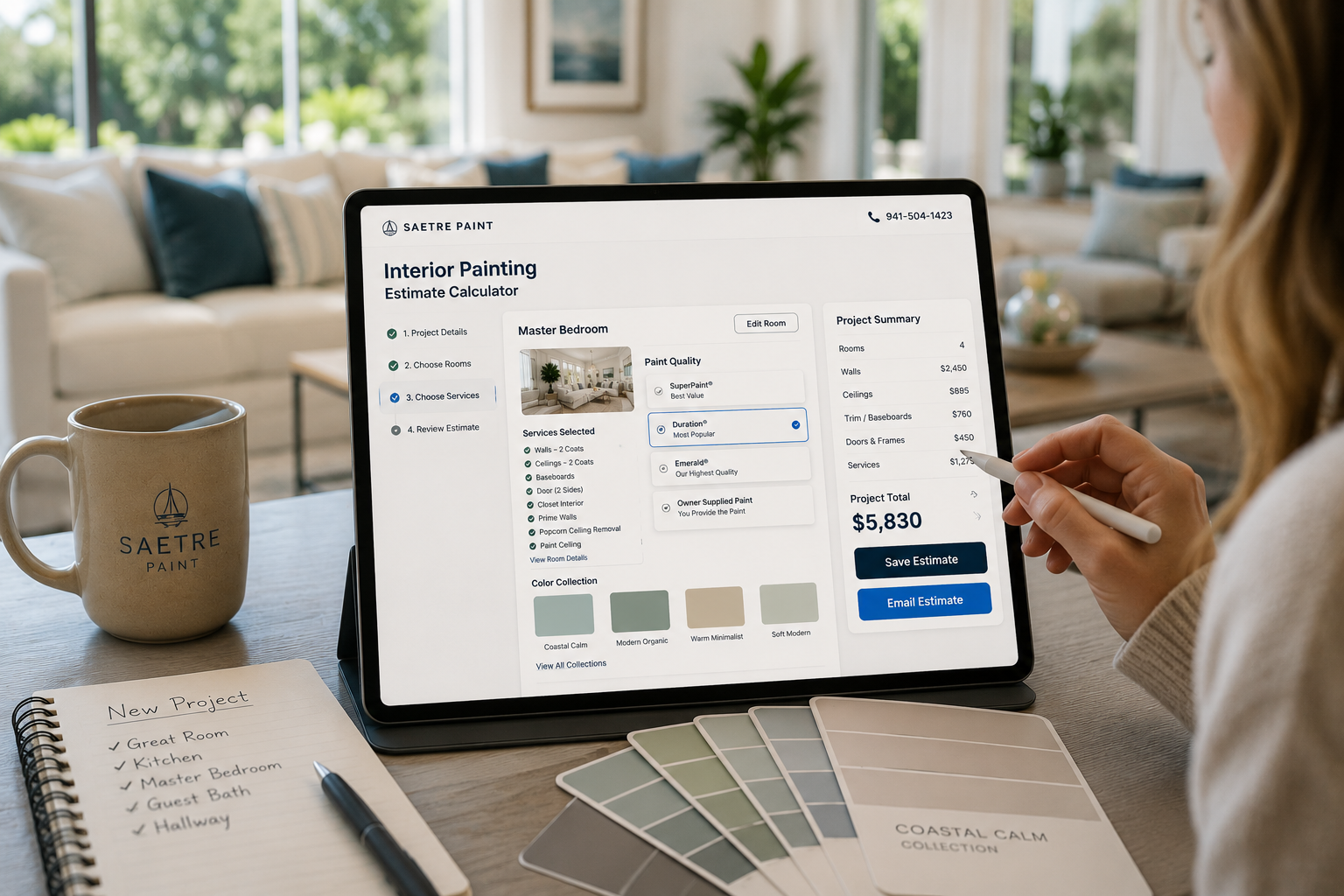
Live Project Pricing
Watch your estimate update instantly as rooms, paint packages, and services are added or removed.
Compare Premium Paints
Compare SuperPaint, Duration, Emerald, and owner-supplied paint options before making your decision.
Designer Color Collections
Preview professionally curated Sherwin-Williams inspired color palettes designed for real Sarasota homes.
Plan Before You Schedule
Build your project at your own pace, understand the investment, and request your complimentary in-home estimate when you're ready.
Every estimate is based on how professional painters actually price residential projects.
The Saetre Paint Interior Painting Estimate Calculator wasn't created from a generic online formula. It was developed using thousands of hours of real residential painting experience serving homeowners throughout Sarasota and the surrounding communities.
Every room type, paint package, ceiling option, trim selection, closet, drywall repair, and popcorn ceiling removal service has been carefully organized to reflect the same estimating process used when preparing professional residential painting proposals.
Instead of guessing, homeowners can compare options, understand how each decision affects their investment, and build a detailed project estimate before scheduling a complimentary in-home consultation.

Professional Estimating Process
Built around the same workflow professional residential painters use when preparing detailed project proposals.
Real Sarasota Experience
Designed from years of painting homes throughout Sarasota and nearby communities—not generic national averages.
Transparent Planning
Compare rooms, paint systems, and services before requesting your free in-home estimate.
Estimate With Confidence
Understand your project scope and investment before the first appointment is ever scheduled.
Professional planning leads to better painting projects.
A successful painting project starts long before the first drop cloth is unfolded. The Saetre Paint Interior Painting Estimate Calculator helps homeowners organize their project, compare options, and understand pricing before scheduling an in-home consultation.
Explore multiple room combinations, compare premium paint systems, preview designer-inspired Sherwin-Williams color collections, and build an estimate that matches your home's unique needs. Every adjustment updates your project instantly, giving you a clear picture of the investment before work begins.
Built from real residential painting experience throughout Sarasota, the calculator transforms what is normally a confusing estimating process into a simple, interactive planning experience that homeowners can complete at their own pace.

Organized Project Planning
Build your estimate step by step with an intuitive workflow designed specifically for residential painting projects.
Instant Estimate Updates
Every room, service, and paint selection automatically updates your project total in real time.
Designer Color Inspiration
Browse professionally curated Sherwin-Williams inspired color collections before making your final selections.
Built for Sarasota Homes
Created by a local painting contractor using real estimating experience from thousands of residential painting projects.
Estimate your painting project from anywhere.
Whether you're relaxing at home, walking through a property, or planning your next renovation, the Saetre Paint Interior Painting Estimate Calculator is fully optimized for phones and tablets. Every feature is designed to be fast, intuitive, and easy to use on any screen.

Works on Every Device
Build your estimate on your phone, tablet, laptop, or desktop without downloading an app.
Live Project Updates
Project totals update instantly as rooms, paint options, and services are added or adjusted.
Designed for Real Homes
Estimate bedrooms, kitchens, bathrooms, great rooms, hallways, closets, ceilings, trim, and more.
Ready When You Are
Save time by exploring project options before scheduling your complimentary in-home estimate with Saetre Paint.
Professional Estimating • Transparent Pricing
How We Calculate Interior Painting Costs in Sarasota
A professional painting estimate is based on much more than square footage. We consider the room, the surfaces, the preparation, the paint system and the level of detail required to complete the work properly.

Measurements, room features and selected services are reviewed together so homeowners can understand what influences the cost of their project.
How is an interior painting estimate calculated?
Interior painting costs are calculated by evaluating the rooms and surfaces being painted, ceiling height, surface condition, preparation, trim and doors, paint products and specialty features. These factors determine the labor, materials and setup required. Saetre Paint’s room-by-room calculator organizes those variables to give Sarasota homeowners a realistic starting estimate before an in-home review.
Every estimate should reflect the actual project.
Two rooms can appear similar and still require very different amounts of work. A room with standard ceilings, smooth walls and limited trim is not estimated the same way as a room with twelve-foot ceilings, crown molding, drywall repairs and several color changes.
That is why a dependable residential painting estimate should identify the individual parts of the project instead of relying on one generic price per square foot. The objective is not simply to produce a number. It is to explain what the number represents.
Our online interior painting calculator allows homeowners to explore rooms, surfaces, paint packages and optional services independently. A final in-home consultation can then confirm measurements, existing conditions and the exact scope of work.
What goes into a professional interior painting estimate?
These are some of the primary factors that determine how much labor and material a residential painting project requires.
Room Size and Surface Area
Larger rooms generally require more paint, preparation and working time. Walls, ceilings and trim are evaluated as separate surfaces because each one requires a different application process.
- Wall and ceiling dimensions
- Number of windows and openings
- Amount of baseboard and crown molding
- Room layout and accessibility
Ceiling Height
Taller ceilings increase setup time and the amount of wall surface being painted. They can also require taller ladders, platforms and additional cutting-in around the ceiling line.
- Standard-height rooms
- Twelve- and fourteen-foot walls
- Vaulted or sloped ceilings
- High stairwells and open foyers
Surface Preparation
Preparation has a direct effect on both appearance and durability. The existing condition of the walls and trim determines how much repair, sanding, caulking or priming is needed before finish paint is applied.
- Filling nail holes and minor dents
- Repairing drywall damage
- Sanding rough or patched areas
- Caulking gaps around trim
- Spot priming repaired surfaces
Doors, Trim and Crown Molding
Detailed surfaces are usually estimated separately from walls because they require different products, masking and application techniques. Smooth enamel finishes also demand more precision than broad wall surfaces.
- Baseboards and door casings
- Interior doors and frames
- Crown molding and decorative trim
- Closets, shelving and built-ins
Paint Products and Finishes
Paint products differ in price, coverage, washability, durability and appearance. The correct product depends on the surface, the room and how much wear the finish is expected to receive.
- Washable finishes for interior walls
- Flat finishes for ceilings
- Durable enamel for trim and doors
- Primer for repairs, stains or major color changes
Specialty Features
Architectural details and project-specific upgrades can increase the amount of masking, cutting-in, preparation or finish work required.
- Accent walls and multiple colors
- Built-in shelving and cabinetry
- Decorative wall treatments
- Popcorn ceiling removal
- Large windows and open-concept spaces
Local conditions can affect product selection and preparation.
Homes in Sarasota and the surrounding Gulf Coast communities are exposed to strong sunlight, seasonal humidity and long periods of air-conditioning. These conditions can influence how surfaces age, how repairs dry and which paint products are best suited for the home.
Coastal residences, waterfront properties and frequently occupied seasonal homes may also require additional attention to moisture, fading, existing coatings and ventilation.
Humidity and Drying Conditions
Humidity can affect drying time, surface preparation and the scheduling of repairs and finish coats.
Strong Natural Sunlight
Large windows and bright Florida light can reveal surface imperfections and influence color and sheen selection.
Open Floor Plans
Connected living spaces often require careful color transitions and consistent wall and ceiling finishes.
Luxury Trim and Architectural Detail
Crown molding, detailed casings, high ceilings and built-ins can add significant precision work to an interior project.
Homeowners should be able to explore painting costs before scheduling an appointment.
Many homeowners want a realistic idea of project cost before inviting a contractor into their home. Saetre Paint’s online room-by-room calculator was created to make that early planning process clearer and more useful.
Instead of providing one broad whole-house estimate, the calculator lets homeowners select individual rooms, surfaces, paint packages and optional services. This makes it easier to understand how each decision affects the estimated project total.
What the online estimate can—and cannot—confirm
- Selected rooms and common residential spaces
- Walls, ceilings, trim, doors and closets
- Standard ceiling-height adjustments
- Paint-package differences
- Priming and common optional services
- Popcorn ceiling removal by square footage
- Exact measurements and surface quantities
- Drywall damage and preparation requirements
- Moisture, stains or adhesion concerns
- Access, furniture and protection needs
- Special architectural details
- The final agreed scope and fixed proposal
A dependable painting estimate explains the work—not just the price.
Interior painting costs are influenced by room size, ceiling height, preparation, trim, paint products and architectural details. Saetre Paint’s calculator is designed to organize those variables and provide Sarasota homeowners with a realistic, transparent starting estimate.
The final in-home review confirms the exact conditions and scope before a formal proposal is prepared.
Why Sarasota Homeowners Choose Saetre Paint
Local Expertise. Premium Results. A Better Painting Experience.
Choosing a painting company is about more than comparing prices. Homeowners need confidence that the project will be carefully planned, professionally completed and clearly communicated from beginning to end.

A successful painting project begins with careful planning, honest communication and recommendations suited to the home.
Why do Sarasota homeowners choose Saetre Paint?
Sarasota homeowners choose Saetre Paint for transparent estimating, careful preparation, premium materials, clear communication and local experience with Gulf Coast homes. The objective is not simply to apply paint. It is to provide a dependable residential painting experience with a clearly defined scope, professional workmanship and recommendations suited to the home and its conditions.
A better result starts with a better process.
A professional painting experience begins before the first gallon is opened. Homeowners should understand the proposed work, the products being recommended, the preparation that may be required and how the project will be scheduled.
Saetre Paint approaches residential painting as a complete homeowner service rather than a simple coating application. That means evaluating the condition of the surfaces, discussing priorities and creating a scope that reflects the actual home.
The goal is to remove uncertainty wherever possible. Clear estimating, thoughtful planning and consistent communication help homeowners make informed decisions and know what to expect throughout the project.
What homeowners should expect from a professional painter
These principles shape how we estimate, plan and complete residential painting projects throughout Sarasota and the surrounding Gulf Coast communities.
Local Sarasota Experience
Homes along Florida’s Gulf Coast have distinctive architecture, environmental conditions and homeowner expectations. Local experience helps guide preparation, product selection and project planning.
- Coastal and waterfront properties
- Seasonal residences and condominiums
- Modern open-concept homes
- Luxury trim and high ceilings
Transparent Estimating
Homeowners should understand what they are paying for. Our room-by-room calculator and in-home review are designed to organize the project into clear, understandable parts.
- Room-by-room project planning
- Separate surfaces and optional services
- Clear paint-package choices
- Final scope confirmed before work begins
Careful Surface Preparation
The appearance and durability of a paint finish depend heavily on the condition of the surface beneath it. Preparation is evaluated as part of the project rather than treated as an afterthought.
- Minor drywall repairs
- Sanding and surface smoothing
- Caulking gaps around trim
- Priming where conditions require it
Clear Communication
Homeowners should not have to guess what is happening with their project. Clear communication helps keep the scope, schedule and expectations aligned from the first consultation through the final walkthrough.
- Project details explained before work begins
- Questions answered in understandable language
- Schedule updates communicated clearly
- Changes reviewed before additional work is performed
Professional Paint Systems
Different surfaces require different coatings. Walls, ceilings, trim, doors and repaired areas should be matched with products selected for their intended use, appearance and expected level of wear.
- Washable interior wall finishes
- Low-reflection ceiling coatings
- Durable enamel for trim and doors
- Primer selected for the existing surface
Respect for Your Home and Schedule
A painting project takes place inside a homeowner’s living space. Professional service includes protecting the home, organizing the work and respecting the schedule agreed upon during project planning.
- Furniture and floor protection
- Organized tools and work areas
- Clear daily project planning
- Cleanup and final review
Professional painting should feel organized from the beginning.
The quality of a project is not measured only by the final color on the walls. It is also reflected in how clearly the work is explained, how carefully the home is protected and how consistently the agreed scope is followed.
Sarasota-area homes require more than generic recommendations.
Climate, architecture and occupancy patterns vary throughout the Gulf Coast. A waterfront condominium, a seasonal residence, a newer Lakewood Ranch home and an older Sarasota property may each require different preparation and project planning.
Sarasota and Palmer Ranch
These homes may include open floor plans, high ceilings, detailed trim and strong natural light that makes surface quality and finish selection especially important.
Siesta Key and Longboat Key
Coastal and waterfront properties may require additional attention to moisture, salt exposure, sunlight and the condition of existing coatings.
Lakewood Ranch
Newer homes often feature connected living spaces, modern trim packages and large wall surfaces where consistent color, sheen and application are essential.
Osprey, Nokomis and Venice
Homes throughout the southern Gulf Coast may include a mix of newer construction, seasonal residences and established properties with different repair and preparation needs.
Bradenton
Residential projects can range from complete interior updates to focused room-by-room painting, making clear scope development especially valuable.
Florida Gulf Coast Conditions
Humidity, air-conditioning, sunlight and seasonal occupancy can all influence drying conditions, coating performance and project scheduling.
A clear residential painting process
Every project is different, but the homeowner should always understand what happens next. A structured process helps turn an estimate into an organized, professionally managed project.
Explore the Project
Use the online calculator to select rooms, surfaces, paint packages and optional services.
Review the Home
Measurements, surface conditions, repairs and architectural details are reviewed during the in-home consultation.
Confirm the Scope
The selected services, products and preparation requirements are organized into a clear written proposal.
Prepare the Home
Floors, furniture and surrounding areas are protected before repairs, sanding, caulking and priming begin.
Complete the Painting
The agreed paint system is applied according to the defined scope and surface requirements.
Final Walkthrough
The completed work is reviewed, final details are addressed and the home is left clean and organized.
Referrals are earned through the complete experience.
Homeowners often recommend a painting company because the project felt dependable from beginning to end—not simply because the walls received a new color.
Clear expectations, careful preparation, respectful service and consistent workmanship all contribute to whether a homeowner feels confident recommending the company to a friend, neighbor or real estate professional.
Respectful Homeowner Service
The home is treated as an occupied living space—not simply as a jobsite.
Communication Without Confusion
The project scope, products, schedule and next steps should remain understandable throughout the work.
Workmanship Homeowners Can Trust
Preparation, application and final details are completed according to the defined scope of work.
One local company for the connected parts of your project
Residential painting projects often involve more than walls. Preparation, repairs, ceilings, trim and cleaning can all affect the finished result and the sequence of the work.
Interior Painting
Walls, ceilings, trim, doors, closets and complete room-by-room interior updates.
Exterior Painting
Exterior coatings and preparation suited to stucco, trim and Florida Gulf Coast conditions.
Cabinet Painting
Detailed cabinet preparation and finish systems designed for appearance, hardness and everyday use.
Popcorn Ceiling Removal
Removal, skim coating, priming and painting for a smooth, updated ceiling finish.
Drywall Repair
Minor drywall repairs and surface correction completed before the finish painting begins.
Pressure Cleaning
Exterior cleaning for homes, driveways, pool areas and other surfaces where appropriate.
The right painter should give you confidence before, during and after the project.
Sarasota homeowners should expect more than a quick price and a coat of paint. A dependable residential painting company should explain the scope, recommend appropriate materials, prepare surfaces carefully, communicate clearly and respect the home throughout the process.
Saetre Paint’s objective is to combine local knowledge, transparent estimating and professional workmanship into a smoother, more predictable homeowner experience.
Start with a room-by-room estimate.
Explore your project online, compare options and see how individual rooms and services affect the estimated total. When you are ready, an in-home consultation can confirm the final measurements, conditions and scope.
Why Some Paint Jobs Last 15 Years While Others Fail in 3
Many homeowners assume the paint itself determines how long a paint job lasts. In reality, long-term performance depends on preparation, primer selection, application methods, environmental conditions and ongoing maintenance.

What makes one paint job last significantly longer than another?
A long-lasting residential paint job depends on much more than choosing an expensive paint. Proper cleaning, repairs, sanding, caulking, priming, selecting the correct coating for each surface, applying the recommended number of coats and allowing adequate drying time all work together to create a durable finish. Florida's humidity, sunlight and coastal conditions also play an important role in how long interior and exterior coatings perform.
Paint longevity is built in layers—not with one magic product.
Professional painters understand that durable finishes are the result of many small decisions made correctly throughout the project. Every step builds on the one before it. Skipping even one important step can dramatically shorten the life of an otherwise beautiful paint job.
Proper Surface Preparation
Preparation is often the single biggest factor affecting paint performance. Dirt, grease, glossy finishes, loose paint, damaged drywall and cracked caulking all reduce paint adhesion if left untreated.
- Clean surfaces thoroughly
- Repair drywall damage
- Sand rough areas
- Remove peeling paint
- Caulk gaps before painting
Using the Correct Primer
Primer creates the bond between the existing surface and the finish coat. Different surfaces require different primers, especially after repairs, stain blocking or dramatic color changes.
- Fresh drywall repairs
- Water stains
- Dark color transitions
- Glossy surfaces
- Adhesion improvement
Professional Paint Systems
Not every coating belongs on every surface. Walls, ceilings, trim, doors and cabinetry all perform best when paired with products designed specifically for those applications.
- Washable wall finishes
- Low-sheen ceiling coatings
- Trim enamels
- Cabinet finishes
- Durable premium products
The Correct Number of Coats
A finish coat must provide consistent coverage, color depth and film thickness. One coat may not be enough when covering repaired areas, strong colors, uneven surfaces or major color changes.
- More even color and sheen
- Improved surface protection
- Better coverage over repairs
- More consistent touch-up performance
- Proper coating thickness
Proper Drying and Curing
Paint may feel dry before it has fully cured. Recoating too soon, exposing a fresh finish to moisture or placing furniture against newly painted surfaces can weaken the coating and leave permanent marks.
- Follow manufacturer recoat times
- Allow repairs and primer to dry
- Control humidity where possible
- Avoid early washing or scrubbing
- Protect trim and doors while curing
Ongoing Homeowner Maintenance
Even a professionally applied coating benefits from reasonable maintenance. Addressing leaks, cleaning gently and repairing small areas early can prevent minor problems from becoming larger failures.
- Repair moisture sources promptly
- Use mild cleaning products
- Avoid aggressive scrubbing
- Touch up damaged areas early
- Maintain caulking and ventilation
Durable results come from the complete paint system.
Premium paint cannot compensate for contamination, moisture, inadequate preparation or the wrong primer. Long-term performance depends on every layer working together—from the original substrate to the final finish coat.
Why do some paint jobs fail early?
Early paint failure usually has an identifiable cause. Peeling, blistering, flashing, cracking and poor adhesion are often symptoms of moisture, contamination, incompatible coatings, skipped preparation or improper application—not simply “bad paint.”
Peeling or Poor Adhesion
Paint can release from the surface when applied over dust, grease, chalking, loose coatings or glossy finishes that were not properly cleaned, sanded or primed.
Moisture and Blistering
Water intrusion, condensation and trapped moisture can create bubbles or blisters beneath a coating. The source of moisture must be corrected before repainting.
Flashing and Uneven Sheen
Repaired or porous areas can absorb paint differently from the surrounding wall. Spot priming and consistent application help prevent dull or shiny patches.
Cracking and Premature Wear
Excessively thick coats, brittle older finishes, movement in the substrate or incompatible coatings can contribute to cracking and premature deterioration.
Florida’s climate changes how paint should be selected and applied.
Painting methods that perform well in a dry, mild climate may not respond the same way in Sarasota. Humidity, strong sunlight, coastal exposure, air-conditioning and seasonal occupancy all influence preparation, drying and long-term coating performance.
These conditions do not automatically cause paint failure. They do, however, make product compatibility, moisture control and proper application especially important.
Humidity and Moisture
High humidity can slow drying, affect repairs and contribute to moisture-related failures when leaks, condensation or damp substrates are not corrected before painting.
Strong Florida Sunlight
Intense natural light can make surface defects, roller marks and sheen differences more visible. Exterior ultraviolet exposure can also accelerate fading and coating deterioration.
Salt Air Exposure
Homes near the coast may collect salt and airborne residue on exterior surfaces. Proper cleaning is necessary before repainting so the new coating can bond correctly.
Air-Conditioned Interiors
Temperature differences between cooled interiors and humid outdoor air can contribute to condensation around vents, windows and other vulnerable areas.
Seasonal Occupancy
Sarasota-area homes that remain unoccupied for part of the year may experience changing ventilation and humidity levels. Existing moisture concerns should be addressed before painting.
Waterfront Properties
Waterfront homes may require closer inspection of existing coatings, caulking, moisture exposure and corrosion-prone areas before exterior preparation begins.
Interior and exterior paint fail for different reasons.
Interior coatings are usually affected by wear, cleaning, moisture and surface movement. Exterior coatings face sunlight, rain, heat, salt exposure and changing weather conditions.
Common interior durability concerns
- Bathroom and laundry-room moisture
- Scuffs in hallways and high-traffic rooms
- Grease and residue in kitchens
- Furniture rubbing against walls
- Frequent cleaning with aggressive products
- Cracking around trim and drywall joints
Interior longevity depends on washable products, proper repairs, compatible primers and choosing the correct sheen for the room.
Common exterior durability concerns
- Strong ultraviolet exposure
- Rain and wind-driven moisture
- Salt and airborne contamination
- Chalking or deteriorated older coatings
- Cracked stucco and failed caulking
- Painting over damp or unstable surfaces
Exterior longevity depends on cleaning, repairing, conditioning and coating the surface with products suited to Florida exposure.
The same paint is not the right solution for every home.
Product selection and preparation should reflect the surface, environment and way the space is used. These examples show why a professional estimate must evaluate more than color and square footage.
Bright open-plan walls with strong natural light
A newer home may have relatively smooth walls but large connected spaces and strong window light. Consistent rolling technique, uniform sheen and careful touch-ups become especially important.
Waterfront exterior exposed to salt and sunlight
A coastal exterior may require thorough washing, inspection of chalking, repaired cracks and coatings designed for strong ultraviolet and moisture exposure.
Previously painted walls with repairs and mixed coatings
Older interiors may include patched drywall, glossy trim, previous color changes and uneven porosity. Preparation and selective priming help create a uniform final appearance.
Hallways, family rooms and frequently cleaned surfaces
Busy living spaces need coatings selected for washability and abrasion resistance. A low-quality product may mark or polish unevenly after repeated cleaning.
The difference is often what happens before the finish coat.
- Inspect the existing surface
- Identify moisture or adhesion concerns
- Clean and prepare before coating
- Repair and prime where required
- Use products designed for the surface
- Respect drying and recoat times
- Paint directly over dirt or gloss
- Ignore stains or moisture sources
- Skip sanding and spot priming
- Use one product for every surface
- Apply overly heavy or rushed coats
- Assume premium paint solves every issue
Simple maintenance can extend the life of a professional paint job.
Paint is a protective finish, but it is not maintenance-free. Homeowners can help preserve walls, trim and exterior coatings by correcting moisture problems early, cleaning gently and addressing small defects before they spread.
Correct Moisture Sources Quickly
Repair roof leaks, plumbing leaks, condensation and failed exterior caulking before moisture damages the coating or the underlying surface.
Clean Painted Surfaces Gently
Use mild soap, soft cloths and limited pressure. Strong cleaners, abrasive pads and aggressive scrubbing can polish, dull or remove the finish.
Save the Paint Information
Keep a record of the manufacturer, product, color and sheen used. Accurate information makes future touch-ups and maintenance easier.
Address Small Damage Early
Repair chips, cracks, failed caulking and damaged drywall before the affected area becomes larger or allows moisture behind the coating.
Allow Fresh Paint to Cure
Avoid heavy cleaning, adhesive hooks, furniture pressure and repeated contact until the coating has had adequate time to cure.
Inspect Exterior Surfaces Regularly
Periodically check stucco, trim, doors, caulking and high-exposure areas for fading, cracking, chalking or moisture-related damage.
How long should a residential paint job last?
There is no single lifespan that applies to every surface. Interior and exterior coatings age differently, and actual performance depends on preparation, product quality, exposure, maintenance and how heavily the surface is used.
Often several years or longer
Bedrooms and low-traffic rooms generally remain presentable longer than hallways, kitchens, bathrooms and family rooms.
Biggest variables:- Traffic and cleaning frequency
- Moisture and ventilation
- Product washability
- Children, pets and furniture contact
Performance depends heavily on use
Door edges, hand-contact areas and baseboards receive more wear than broad wall surfaces and benefit from harder enamel coatings.
Biggest variables:- Surface preparation
- Enamel hardness
- Drying and curing time
- Frequency of contact and cleaning
Exposure determines the maintenance cycle
Exterior paint life varies by orientation, substrate, sunlight, coastal exposure, moisture and the condition of the previous coating.
Biggest variables:- UV exposure
- Rain and salt air
- Stucco and caulking condition
- Cleaning and preparation quality
Any lifespan estimate should be treated as general guidance rather than a guarantee. A professional inspection is the best way to evaluate the condition of a specific surface and coating system.
Paint durability questions Sarasota homeowners often ask
These answers explain the practical factors that influence adhesion, appearance and long-term coating performance.
Does expensive paint automatically last longer?
Not automatically. Premium paint can provide better coverage, washability, color retention and durability, but it still depends on proper preparation and application. Expensive paint applied over dirt, moisture, loose coatings or glossy surfaces may still fail early.
Is primer always required before painting?
Primer is not required on every previously painted surface, but it is often necessary over drywall repairs, bare materials, stains, glossy surfaces, porous areas and major color changes. The correct decision depends on the condition and compatibility of the existing surface.
Why does paint peel in bathrooms?
Bathroom peeling is commonly related to moisture, condensation, inadequate ventilation, contamination or poor adhesion. The moisture source should be addressed before loose paint is removed, the surface is repaired and the area is repainted.
Do two coats always last longer than one?
Two properly applied finish coats often provide better coverage, color consistency and coating thickness. However, the number of coats alone does not determine durability. Preparation, primer, product selection and drying conditions remain equally important.
Why do patched areas sometimes look shiny or dull?
Drywall compound and repaired areas can absorb paint differently from the surrounding wall. This can create flashing or uneven sheen. Spot priming and applying the finish consistently across the full surface help reduce the difference.
How soon can newly painted walls be cleaned?
Paint may dry quickly but require more time to cure fully. Avoid aggressive cleaning during the early curing period and follow the product manufacturer’s guidance. When cleaning begins, use a soft cloth and mild solution.
What causes exterior paint to fade in Florida?
Strong ultraviolet exposure is a major cause of fading. Product quality, color choice, orientation of the home, coastal exposure and the condition of the existing coating also influence how quickly the finish changes.
Can paint fix cracks or moisture problems?
No. Paint may temporarily cover a visible defect, but it does not correct movement, water intrusion, failed caulking, damaged drywall or structural cracking. The underlying cause should be repaired before repainting.
A long-lasting paint job is the result of the complete process.
Paint durability depends on the condition of the surface, the quality of the preparation, the primer, the coating selected, the number of coats, the drying conditions and the way the finished surface is used and maintained.
Premium paint matters, but it cannot correct moisture problems, poor adhesion, skipped repairs or incompatible coatings. The strongest results come from treating preparation, product selection and application as one complete paint system.
Start by understanding the rooms, surfaces and services involved.
Saetre Paint’s online room-by-room interior painting calculator allows Sarasota homeowners to explore walls, ceilings, doors, baseboards, closets, priming, paint packages and popcorn ceiling removal before scheduling an in-home consultation.
The online estimate provides a practical starting point. The final in-home review confirms measurements, surface conditions, repairs and the exact scope before a written proposal is prepared.
Explore Your Project
Select individual rooms and services based on the work you are considering.
Compare Your Options
See how paint packages, ceiling height and additional surfaces influence the estimated total.
Confirm the Details
Schedule an in-home consultation when you are ready to confirm the scope and conditions.
Build your free room-by-room painting estimate.
Explore your project online at your own pace, then let Saetre Paint confirm the details during a complimentary in-home consultation.
Understanding Painting Estimates Is About More Than Finding the Lowest Price
Choosing a painting contractor is one of the last decisions many homeowners make before transforming the appearance, durability, and long-term value of their home. While the final color selection often receives the most attention, the estimating process is where a successful project truly begins. A thoughtful estimate establishes expectations, identifies the work that will be performed, explains what influences cost, and provides homeowners with enough information to make informed comparisons rather than emotional decisions.
Why Online Painting Calculators Have Become So Valuable
Years ago, the only way to receive a painting estimate was to schedule several companies, wait for appointments, and compare handwritten proposals that often varied dramatically in detail. Modern homeowners now begin their research differently. Before inviting anyone into their home, they want to understand realistic price ranges, typical project costs, and the factors that influence those numbers. A professional online painting calculator helps answer those questions long before an appointment is scheduled.
Instead of replacing the experience of meeting with a professional estimator, a well-designed calculator provides education. It allows homeowners to explore different rooms, compare painting options, understand how ceilings, trim, doors, drywall repairs, or premium coatings affect pricing, and develop realistic expectations before requesting a detailed proposal. That transparency benefits both homeowners and professional painting companies because conversations begin with better information rather than uncertainty.
Professional estimating is not about producing the fastest number possible. It is about creating an accurate scope of work that reflects the unique characteristics of each home, the materials selected, the preparation required, and the quality standard expected when the project is complete.
Why Every Home Produces a Different Estimate
One of the most common questions homeowners ask is why two houses with similar square footage can receive noticeably different painting estimates. The answer is that professional painting is measured by complexity rather than square footage alone. Ceiling heights, architectural details, wall condition, trim profiles, window counts, cabinet layouts, surface repairs, furniture protection, accessibility, previous coatings, sheen changes, and even lighting conditions all influence the amount of labor required to achieve a consistent finish.
A room with smooth walls in excellent condition may require very little preparation before painting begins, while another room of identical size could need drywall repairs, stain blocking, texture corrections, extensive masking, or multiple primer coats. Because preparation represents a significant portion of professional painting, two projects that appear similar at first glance can require very different amounts of skilled labor.
Preparation Influences Nearly Every Estimate
Surface cleaning, drywall repairs, caulking, sanding, masking, furniture protection, stain treatment, and proper priming frequently determine both the final appearance and the overall cost of a painting project. These steps often require more time than the actual application of paint.
Material Selection Matters
Different paint systems are designed for different environments. Interior walls, trim, ceilings, cabinets, bathrooms, and exterior surfaces each benefit from coatings engineered for their specific conditions, durability requirements, and finish characteristics.
Why a Professional In-Home Estimate Still Matters
An online painting calculator is an excellent planning tool, but it is not intended to replace a professional evaluation of the home. Every property has unique characteristics that simply cannot be measured accurately through square footage alone. Lighting conditions, previous paint failures, moisture concerns, drywall movement, wood repairs, accessibility, furniture placement, ceiling heights, and existing finishes all influence the scope of work.
During an in-home estimate, an experienced estimator verifies measurements, evaluates the condition of every surface, discusses the homeowner's priorities, recommends appropriate products, and answers questions that often arise only after walking through the project together. This process ensures that the final proposal reflects the actual work required rather than assumptions made from generalized information.
The result is a clearer scope of work, fewer surprises during production, and a better understanding between the homeowner and the painting contractor before the first brush or spray gun is ever used.
What Actually Determines the Cost of a Painting Project?
Many homeowners assume paint is the largest expense in a painting project. In reality, professional painting is primarily a skilled labor service. Premium coatings certainly influence overall cost, but preparation, craftsmanship, scheduling, project management, protection of the home, and attention to detail represent the majority of the investment.
Several factors naturally affect the final investment, including the number of rooms being painted, wall and ceiling height, trim complexity, the amount of drywall repair required, cabinet preparation, accent colors, primer requirements, existing surface conditions, occupied versus vacant homes, furniture moving, masking requirements, and the durability level of the selected paint system.
Because every project combines these variables differently, experienced painters rarely rely on a simple cost-per-square-foot formula alone. Professional estimates evaluate the complete scope of work rather than only the size of the home.
Why Painting Estimates Often Vary Between Contractors
One homeowner may receive three estimates for the same project and discover that every proposal is different. While pricing naturally varies between companies, the biggest differences are often found in what is actually included rather than the number printed at the bottom of the page.
Some estimates include comprehensive surface preparation, premium coatings, furniture protection, detailed cleanup, and clearly defined warranties. Others may assume minimal preparation, fewer coats, lower-grade materials, or exclude important items that become additional charges later. Without comparing the actual scope of work, it is impossible to determine which proposal provides the best overall value.
A detailed estimate should explain exactly what will be painted, how surfaces will be prepared, what products will be used, how many coats are included, what repairs are covered, and which items—if any—are excluded. The more transparent the proposal, the easier it becomes for homeowners to compare companies fairly.
The lowest estimate is not automatically the least expensive project, and the highest estimate is not automatically the best. The real value comes from understanding exactly what work is being performed, how it will be completed, and the level of craftsmanship expected when the project is finished.
Comparing Painting Estimates the Right Way
Instead of focusing exclusively on price, homeowners should compare estimates by examining the complete scope of work. Preparation procedures, repair allowances, paint specifications, application methods, scheduling, communication, insurance coverage, warranty information, and overall professionalism all contribute to the long-term success of a painting project.
Questions worth asking include whether damaged drywall will be repaired before painting, whether stains will be properly sealed, how trim and flooring will be protected, which paint line will be used, whether two finish coats are included where appropriate, and how unexpected conditions will be handled if they are discovered after work begins.
Clear answers to these questions generally indicate a well-developed estimating process and a contractor who values transparency throughout the project rather than relying on vague pricing or assumptions.
What Separates Professional Painters from Low-Price Contractors?
Not every painting proposal represents the same level of planning, craftsmanship, or long-term value. While homeowners naturally compare prices, experienced estimators know that the quality of the finished project is determined long before the first coat of paint is applied. Preparation standards, product knowledge, communication, scheduling, and attention to detail often separate professional painting companies from contractors competing primarily on price.
Professional painters typically invest considerable time before work begins. They inspect surfaces carefully, identify repairs, recommend appropriate coating systems, explain the scope of work clearly, protect surrounding finishes, and establish realistic expectations for both the process and the completed project. Their estimates are intended to reduce uncertainty rather than create it.
Lower-priced proposals may still represent legitimate businesses, but homeowners should understand exactly why the price differs. The difference may involve fewer preparation steps, lower-grade materials, fewer finish coats, less detailed cleanup, reduced project supervision, or work that simply falls outside the written proposal. Asking thoughtful questions before work begins is often far easier than resolving misunderstandings after the project is underway.
The Role of Premium Paints and Professional Materials
Paint technology has improved significantly over the past several decades. Today's premium coatings provide better color retention, improved washability, smoother finishes, stronger adhesion, lower odor, and greater durability than many older formulations. Selecting the appropriate product for each surface helps maximize both appearance and long-term performance.
Interior walls, ceilings, trim, cabinets, bathrooms, kitchens, and exterior surfaces each experience different levels of wear, humidity, sunlight, and cleaning. Professional estimators evaluate these conditions before recommending a specific coating system instead of assuming that one paint performs equally well everywhere throughout the home.
Equally important are the materials that never appear in the finished photographs. Primers, fillers, caulks, patching compounds, masking products, abrasives, dust-control equipment, and specialized application tools all contribute to a cleaner process and a more consistent final result. These supporting materials are often overlooked when comparing estimates, yet they play an essential role in producing durable workmanship.
Experience Improves Efficiency
Experienced painters often complete projects more efficiently because they recognize potential challenges before they become costly delays. Proper planning reduces unnecessary interruptions and helps maintain consistent quality from the first room to the final walkthrough.
Communication Builds Confidence
Clear communication before, during, and after a project allows homeowners to understand the schedule, preparation requirements, product selections, and expected outcomes. Transparency throughout the estimating process usually leads to a smoother painting experience.
Why Local Knowledge Makes a Difference
Every region presents unique environmental conditions that influence how painting projects are planned. In Sarasota and the surrounding Gulf Coast communities, homes experience intense sunlight, elevated humidity, seasonal rain, salt air near the coast, and long periods of heat throughout the year. These conditions affect product selection, drying times, maintenance expectations, and the long-term performance of exterior coatings.
Interior painting is also influenced by local architecture. Open-concept floor plans, high ceilings, expansive windows, decorative trim, and coastal design styles require estimating methods that differ from homes in other parts of the country. Understanding these regional characteristics helps professional estimators recommend finishes that complement both the home's design and the local environment.
Whether a project is located in Sarasota, Siesta Key, Lakewood Ranch, Palmer Ranch, Osprey, Nokomis, Venice, or Bradenton, the estimating process should reflect the specific conditions of that property rather than relying on generalized national averages.
Building Confidence Before the Project Begins
For many homeowners, requesting a painting estimate is not simply about receiving a price. It is about understanding the process, evaluating available options, and gaining confidence before making an important investment in their home. A transparent estimating experience should answer questions, reduce uncertainty, and provide enough information for thoughtful decision-making without unnecessary pressure.
That is one of the reasons online estimating tools have become increasingly valuable. They encourage homeowners to explore possibilities, compare project scopes, and become familiar with the factors that influence pricing long before scheduling an in-home consultation. Better information almost always leads to better decisions.
A well-prepared estimate should leave homeowners feeling informed rather than overwhelmed. Instead of creating uncertainty, it should explain the work, identify potential variables, outline realistic expectations, and provide confidence that the finished project has been carefully planned from the very beginning.
Questions Homeowners Commonly Ask Before Hiring a Painting Contractor
Homeowners researching painting services often begin with similar questions. How much does it cost to paint a room? Why are estimates different? Should premium paint be worth the extra investment? Is surface preparation really necessary? How long will the project take? Will furniture be protected? How many coats of paint are included? Can damaged drywall be repaired before painting begins? What happens if additional repairs are discovered after work starts?
These are practical questions because every painting project represents a combination of craftsmanship, planning, materials, scheduling, and communication. A professional estimate should answer many of these questions naturally before the homeowner even needs to ask them. The clearer the proposal, the easier it becomes to understand exactly what is being purchased.
Professional estimators also recognize that every homeowner has different priorities. Some value maximum durability because they expect to remain in the home for many years. Others may be preparing a property for sale, updating a recently purchased home, renovating after water damage, or simply refreshing a favorite room. Understanding these goals allows recommendations to be tailored to the project instead of applying the same approach to every home.
Using an Online Estimate as a Planning Tool
An online painting calculator is most valuable when it is viewed as a planning resource rather than a final contract price. It allows homeowners to explore different combinations of rooms, compare optional services, understand how project scope affects investment, and prepare realistic budgets before scheduling an in-home consultation.
Many homeowners also use online estimates to prioritize future improvements. A complete whole-home repaint may be divided into phases, with living areas completed first, bedrooms scheduled later, or cabinets and trim included during a future renovation. Having access to estimated pricing helps families make informed decisions based on their own timeline rather than guesswork.
Because every home is different, final pricing should always reflect actual site conditions, verified measurements, selected products, preparation requirements, and any additional work discussed during the in-home consultation. That final review helps ensure the proposal accurately represents the completed scope of work.
The purpose of a professional estimate is not simply to calculate a price. Its purpose is to define the project clearly enough that both the homeowner and the painting contractor share the same expectations before work begins. Clear expectations are one of the strongest predictors of a successful painting project.
A Resource Designed to Help Homeowners Make Better Decisions
The most valuable home improvement resources do more than generate numbers. They explain how estimates are developed, why pricing changes from one project to another, what questions should be asked before hiring a contractor, and how homeowners can compare proposals fairly. Educational resources help people make informed decisions whether they are planning a single bedroom repaint or a complete interior transformation.
By understanding the estimating process, homeowners are better prepared to evaluate proposals, recognize meaningful differences in scope, appreciate the importance of proper preparation, and select materials that match their expectations for appearance, durability, and long-term value. Knowledge reduces uncertainty, encourages thoughtful comparisons, and leads to more successful projects for everyone involved.
Serving Sarasota and Florida's Gulf Coast with Local Experience
Homes throughout Sarasota, Siesta Key, Lakewood Ranch, Palmer Ranch, Osprey, Nokomis, Venice, and Bradenton share many regional characteristics, yet every property remains unique. Architectural style, age, previous renovations, humidity exposure, sunlight, ceiling height, trim detail, and surface condition all influence the estimating process. A professional evaluation considers these variables individually instead of relying on broad national averages or generic pricing formulas.
Whether the project involves interior painting, exterior painting, cabinet refinishing, ceiling painting, trim painting, drywall repairs, popcorn ceiling removal, or pressure cleaning, careful estimating remains the first step toward delivering a finished result that meets both aesthetic and performance expectations.
The Best Painting Estimates Create Clarity, Not Confusion
A painting estimate should do far more than present a final number. It should explain the scope of work in language that homeowners can easily understand, identify the preparation required for each surface, describe the materials being recommended, and establish realistic expectations before the project begins. When expectations are clear, projects tend to progress more smoothly, communication becomes easier, and the finished results are more likely to meet or exceed what everyone envisioned.
Professional estimating is ultimately a process of problem solving. Every room, ceiling, trim package, cabinet layout, drywall repair, and architectural detail represents its own combination of labor, materials, preparation, and craftsmanship. Taking the time to evaluate those details carefully helps produce proposals that are accurate, transparent, and tailored to the specific home rather than based on assumptions.
For homeowners comparing multiple contractors, one of the most valuable questions is not simply, "Which estimate is lower?" but rather, "Which estimate helps me understand my project the best?" A proposal that clearly defines the work often provides greater long-term value than one that leaves important details open to interpretation.
What This Resource Was Designed to Accomplish
This Interior Painting Calculator was created to help homeowners better understand the estimating process before scheduling an in-home consultation. Rather than replacing a professional visit, it provides a practical starting point for exploring project options, understanding how different services influence pricing, and learning why painting estimates vary from one home to another.
Throughout this guide, the goal has been to explain professional estimating in a way that is straightforward, transparent, and educational. Whether someone is researching painting costs for the first time, comparing multiple proposals, budgeting for a future renovation, or simply learning how professional painters develop estimates, informed decisions begin with reliable information.
Every home has its own story, its own challenges, and its own priorities. Because of that, no calculator, article, or published price list can replace a thoughtful evaluation of the actual property. The most accurate estimates combine digital planning with professional experience, verified measurements, product knowledge, and a detailed understanding of the surfaces being painted.
An online estimate provides direction. A professional in-home estimate provides precision. Together they create a more transparent, informed, and confident painting experience from the very beginning of the project.
Helping Homeowners Make More Informed Decisions
Whether you are estimating the cost to paint a single bedroom, updating an entire interior before moving into a new home, comparing cabinet refinishing options, planning popcorn ceiling removal, or preparing a complete whole-home repaint, understanding the estimating process allows every decision to be made with greater confidence.
Carefully comparing proposals, asking thoughtful questions, understanding the importance of preparation, and evaluating the complete scope of work are often more valuable than focusing on price alone. The best painting projects begin with realistic expectations, open communication, and a shared understanding of what success will look like when the work is complete.
Thank you for taking the time to explore this guide. We hope it has provided useful insight into how professional painting estimates are developed and what homeowners should consider when planning their next painting project.
About Saetre Paint
Saetre Paint is a Sarasota, Florida painting company serving homeowners throughout Sarasota, Siesta Key, Lakewood Ranch, Palmer Ranch, Osprey, Nokomis, Venice, and Bradenton. Services include interior painting, exterior painting, cabinet painting, ceiling painting, trim painting, drywall repairs, popcorn ceiling removal, and pressure cleaning. Every project begins with understanding the home, defining the scope of work clearly, and providing homeowners with the information they need to make confident, informed decisions.
Whether you ultimately choose Saetre Paint or another qualified professional, we believe homeowners deserve estimates that are transparent, easy to understand, and based on careful evaluation rather than guesswork. Better information leads to better projects, stronger communication, and results that last long after the final coat of paint has dried.
Every successful painting project begins with understanding rather than assumptions. An online estimate provides a practical starting point, while a professional in-home consultation refines the details that make every home unique. Together, they create a planning process built on transparency, accurate information, thoughtful preparation, and realistic expectations.
Final Thoughts
Painting is one of the few home improvements that transforms nearly every room people experience every day. Color certainly changes the appearance of a home, but careful preparation, quality materials, experienced craftsmanship, and a clearly defined scope of work are what determine how that transformation performs over time.
Whether you are gathering information, comparing painting estimates, planning a future renovation, or preparing to schedule your project, taking the time to understand the estimating process is one of the smartest investments you can make. An informed homeowner is better equipped to compare proposals fairly, ask meaningful questions, and choose the solution that best fits both the home and the goals of the project.
We hope this guide has served as a helpful educational resource and provided a clearer understanding of how professional painting estimates are developed. Thank you for visiting the Saetre Paint Interior Painting Calculator, and we wish you success with your upcoming painting project.
Saetre Paint proudly serves homeowners throughout Sarasota, Siesta Key, Lakewood Ranch, Palmer Ranch, Osprey, Nokomis, Venice, and Bradenton with professional interior painting, exterior painting, cabinet painting, ceiling painting, trim painting, drywall repairs, popcorn ceiling removal, and pressure cleaning. We believe the best painting experience begins with clear communication, transparent estimating, and craftsmanship that homeowners can trust for years to come.
What Homeowners Should Know About Interior Painting Prices
Interior painting prices are shaped by more than room dimensions. Surface condition, preparation, ceiling height, trim detail, access, repairs, paint selection and the expected finish all influence the amount of work required. This guide explains how professional painters evaluate interior projects and why estimates can differ from one home to another.
Interior Painting Costs and Pricing
These questions address the most common concerns homeowners have when researching room painting costs, whole-home painting prices and professional interior painting estimates.
How much does it cost to paint a room?
The cost to paint a room depends on its dimensions, ceiling height, number of doors and windows, amount of trim, wall condition, preparation requirements and the paint system being used. A simple bedroom with smooth walls and limited furniture may cost less than a similarly sized dining room with crown molding, detailed trim, wall repairs or multiple colors.
Homeowners should confirm whether an estimate includes walls only or also covers ceilings, baseboards, crown molding, doors, door casings, closets and repairs. Two prices may appear similar while representing very different scopes of work.
How much should it cost to paint a 12-by-12 bedroom?
A 12-by-12 bedroom is often used as a pricing example, but floor dimensions alone do not define the work. Ceiling height, wall condition, room contents, closet size, trim, doors and color changes all influence the final estimate. Painting only the walls is a different project from painting the walls, ceiling, baseboards, closet and doors.
A professional painter will also determine whether the room needs patching, sanding, caulking, stain blocking or primer before the finish coats are applied. Those preparation steps can change the price even when the dimensions remain identical.
Do painters charge by the room, square foot or hour?
Painting contractors may use several estimating methods. Some use room-based pricing for common layouts, while others calculate wall or ceiling area, linear footage of trim, quantities of doors and additional preparation time. Hourly labor rates are often used internally to verify that the estimated price supports the amount of work expected.
Homeowners do not always see every internal calculation. What matters is whether the final proposal clearly defines the surfaces, preparation, materials and coats included.
Why do interior painting estimates vary so much?
Estimates often vary because contractors are not pricing the same scope, preparation standard or level of finish. One proposal may include drywall repairs, caulking, sanding, two finish coats, premium paint and detailed protection. Another may assume minimal preparation, fewer applications, lower-cost materials or additional charges for repairs.
Business structure, insurance, crew experience, project management, warranty coverage and scheduling also affect pricing. Homeowners should compare the complete written scope rather than evaluating proposals only by the lowest total.
What affects the cost of interior painting the most?
Labor and preparation usually have the greatest effect on interior painting cost. Damaged walls, heavy patching, peeling coatings, stains, extensive caulking, detailed trim, tall ceilings, occupied rooms and difficult access all increase the time required to complete the work properly.
Product selection also matters, but paint is only one part of the total investment. Skilled labor, protection of the home, surface preparation, equipment, cleanup, supervision and final detailing frequently represent a larger portion of the project.
Does ceiling height increase painting prices?
Yes. Higher ceilings usually require taller ladders, scaffolding, extension equipment, additional protection and slower production. Walls that are ten feet high are generally easier to access than twelve-, fourteen- or sixteen-foot walls, especially around stairways, entry foyers and open living areas.
Height can also affect ceilings, crown molding, upper wall repairs and cut lines. A professional estimate should identify where height changes the labor requirement instead of applying the same rate to every room.
Why does changing from a dark color to a light color cost more?
Significant color changes may require additional coats or a strategically selected primer to achieve even coverage. Deep reds, dark blues, bright accent colors and heavily saturated finishes can be difficult to cover with a lighter color in only one application.
The reverse can also be true. Applying a deep color over a very light surface may require multiple coats for consistent depth. The estimate should reflect the number of applications realistically needed to produce a uniform finish.
Is two coats of paint always necessary?
Two finish coats are often recommended because they improve color consistency, sheen uniformity and durability. However, coating requirements depend on the existing color, new color, surface porosity, product specifications and condition of the substrate. Some repaint situations may achieve full coverage with fewer applications, while major color changes may require primer and additional finish coats.
A professional proposal should explain whether the project is based on a specified number of coats or on achieving full, uniform coverage.
Is an empty home less expensive to paint than an occupied home?
An empty home can often be painted more efficiently because crews spend less time moving furniture, creating pathways, protecting personal belongings and working around household activity. Vacant rooms may also allow several areas to be prepared and painted in a more efficient sequence.
Occupied homes can still be painted safely and professionally, but the estimate may reflect additional protection, room-by-room scheduling and setup time. Homeowners should clarify who is responsible for moving furniture and wall decorations.
Is premium interior paint worth the additional cost?
Premium interior coatings can provide better washability, smoother application, stronger color retention, improved touch-up performance and greater resistance to everyday wear. These benefits are often most valuable in kitchens, bathrooms, hallways, family rooms, children's rooms and other frequently used spaces.
The most expensive paint is not automatically necessary for every surface. Ceilings, walls, trim and cabinets have different performance requirements. An experienced painter should recommend products based on the surface, environment and homeowner's expectations.
How to Understand and Compare Professional Painting Estimates
A painting estimate should explain much more than price. It should define the surfaces being painted, the preparation required, the products being used, the number of coats included, the responsibilities of the homeowner and contractor, and any conditions that could affect the final scope. These answers help homeowners compare proposals accurately and avoid misunderstandings before work begins.
Questions Every Homeowner Should Ask About a Painting Proposal
The strongest estimates reduce uncertainty. Each answer below explains an important part of professional estimating and identifies details homeowners should verify before selecting a painting contractor.
What should a professional painting estimate include?
A professional painting estimate should identify the rooms or exterior areas included, the exact surfaces being painted, the preparation required, the paint products or product standards, the anticipated number of coats, project access requirements, protection procedures, cleanup responsibilities and any exclusions. It should also explain how repairs or additional work will be approved if conditions change after the project begins.
The proposal does not need to describe every brushstroke, but it should be detailed enough that both parties understand what the quoted price includes. Clear language helps homeowners compare estimates fairly and reduces disagreements during production.
How should homeowners compare two painting estimates?
Homeowners should compare the written scope before comparing the final totals. Confirm that both proposals include the same rooms, ceilings, trim, doors, closets, repairs, products and number of coats. One estimate may appear less expensive because important surfaces or preparation steps are not included.
It is also useful to compare communication, scheduling, protection methods, cleanup procedures, insurance, warranty terms and how additional work is authorized. The best value is usually the proposal that offers the clearest combination of scope, workmanship, materials and accountability—not automatically the lowest number.
Why is one painting estimate much lower than the others?
A lower estimate may reflect reduced preparation, fewer coats, less-expensive materials, limited repairs, fewer insured labor costs or a smaller business overhead. It may also result from an honest difference in production methods or from a contractor overlooking part of the project.
Homeowners should not assume that every low estimate is poor or that every high estimate is superior. The important question is whether the lower proposal delivers the same scope and quality standard. Asking the contractor to explain the price difference can reveal whether the savings come from efficiency or from work that is missing.
Is a painting estimate a guaranteed final price?
A written estimate may be presented as a fixed proposal for a clearly defined scope, but it cannot always account for concealed damage or changes requested after work begins. Water damage, failing drywall, hidden wallpaper, excessive peeling, rotten wood or previously unknown coating problems can require additional labor and materials.
A professional proposal should explain which conditions are included and how unforeseen work is handled. Additional charges should be discussed and approved before the extra work proceeds whenever practical. This process protects both the homeowner and the contractor from surprise billing.
Are drywall repairs normally included in a painting estimate?
Minor nail holes and small surface imperfections are often part of normal preparation, but larger drywall repairs may be priced separately. Cracks, settlement damage, failed tape joints, water-damaged areas, texture matching and extensive patching can require specialized materials and multiple visits before painting.
Homeowners should ask what level of repair is included and whether the proposal identifies allowances or separate repair pricing. The expected finish should also be discussed because repaired areas may need broader skim coating, priming or texture work to blend properly under strong lighting.
Should the paint brand and product line be written in the estimate?
Yes. Paint brands often contain several product lines with different durability, washability, coverage and price points. Listing only the manufacturer does not fully describe the coating being supplied. The estimate should ideally identify the product line, sheen and intended surface.
Product substitutions may occasionally be necessary because of availability or project conditions, but they should be discussed before use. Clear material specifications help homeowners compare proposals and confirm that the finished project receives the coating quality that was expected.
Should a proposal specify how many coats of paint are included?
A proposal should explain the coating expectation clearly. Some contractors specify one primer coat and two finish coats, while others promise a uniform finished appearance or full coverage. These approaches can both be reasonable, but vague wording makes estimates difficult to compare.
Major color changes, porous surfaces, repairs and certain deep colors may require additional applications. Homeowners should ask whether the price includes a fixed number of coats, full coverage, or additional charges when the selected color requires more work than originally anticipated.
Should a homeowner pay a deposit before painting begins?
Deposit practices vary by contractor, project size and local business policy. Some companies request a scheduling deposit or material payment, while others collect payment after work begins or at completion. A reasonable deposit should be clearly stated in the written agreement along with the remaining payment schedule.
Homeowners should avoid unclear cash requests or large payments without documentation. Payment terms should identify when funds are due, what milestone triggers each payment and how changes to the project affect the balance.
What should homeowners look for in a painting warranty?
A painting warranty should explain what workmanship issues are covered, how long the coverage lasts and which conditions are excluded. Common exclusions may include water intrusion, structural movement, substrate failure, moisture problems, customer damage and coatings applied over previously failing surfaces.
The length of the warranty matters less than the clarity of its terms and the contractor's ability to respond. Homeowners should keep the written proposal, color information and final invoice so any future concern can be evaluated accurately.
Should the estimate include cleanup and a final walkthrough?
Cleanup and final review should be part of the project expectations. The proposal should explain whether crews remove masking materials, dispose of project debris, return furniture, label leftover paint and clean the immediate work areas.
A final walkthrough gives the homeowner and contractor an opportunity to review completed surfaces, identify legitimate touch-ups and confirm that the written scope has been fulfilled. It is most effective when the home is viewed under normal lighting and when expectations for minor touch-ups were established before the project began.
How to Choose the Right Paint Products, Sheens and Finishes
Paint products are not interchangeable. Walls, ceilings, trim, doors, cabinets and moisture-prone rooms each place different demands on a coating. The right product should balance appearance, washability, durability, application requirements and long-term maintenance rather than relying only on color or price.
Paint Products, Sheens and Material Selection
These questions explain how professional painters select coatings for different surfaces, why sheen affects appearance and maintenance, and when premium products provide meaningful value.
What is the difference between inexpensive and premium interior paint?
Premium paints generally contain higher-quality resins, pigments and additives that improve application, washability, color retention, stain resistance and durability. They may level more smoothly, produce a more consistent sheen and withstand cleaning better than lower-priced coatings.
Inexpensive paint can still be appropriate for low-use areas, temporary improvements or projects with limited performance needs. The correct choice depends on the surface, expected wear, desired finish and how long the homeowner wants the coating to perform.
What paint sheen is best for interior walls?
Matte, flat, eggshell and satin finishes are commonly used on interior walls. Matte and flat finishes minimize reflection and can help reduce the appearance of minor wall imperfections. Eggshell and satin finishes generally offer greater washability and are often selected for active rooms.
The best sheen depends on lighting, wall condition, traffic, cleaning needs and personal preference. Strong natural or artificial light may make higher-sheen coatings reveal more surface irregularities.
Is flat paint a good choice for walls?
Flat paint provides a soft, low-reflective appearance and can help conceal minor surface imperfections. It is often used in adult bedrooms, formal spaces, low-traffic areas and homes where a quiet, uniform finish is preferred.
Traditional flat coatings may be less resistant to repeated scrubbing, although many modern premium matte and flat products offer improved washability. Homeowners should distinguish between basic contractor-grade flat paint and higher-performance washable matte coatings.
What is the difference between eggshell and satin paint?
Eggshell typically has a softer, lower-luster appearance, while satin reflects slightly more light and often provides stronger resistance to moisture and cleaning. Product names vary by manufacturer, so one brand's eggshell may resemble another brand's low satin.
Eggshell is commonly chosen for living areas and bedrooms. Satin is frequently selected for kitchens, bathrooms, hallways and active family spaces. Wall condition and lighting should also be considered because increased sheen can make imperfections more noticeable.
Why should ceilings use a dedicated ceiling paint?
Ceiling paints are generally designed to produce a uniform, low-reflective finish that helps minimize roller marks, lap lines and minor surface irregularities. Their formulation may also reduce splatter and improve application overhead.
Using wall paint on a ceiling can create more reflection than expected, especially near large windows and recessed lighting. Bathrooms and other moisture-prone areas may require a coating with additional mildew resistance or washability.
What type of paint should be used on trim and doors?
Trim and doors benefit from a harder, smoother coating formulated to resist handling, cleaning, blocking and everyday impact. Acrylic enamels, waterborne alkyds and specialized trim coatings are common professional choices.
Satin, semi-gloss and gloss finishes are often used depending on the desired appearance. Preparation is critical because a durable trim coating cannot compensate for grease, loose paint, rough repairs or insufficient sanding beneath the finish.
What paint is best for bathrooms and humid rooms?
Bathrooms need coatings that tolerate moisture, condensation, cleaning and limited ventilation. Premium acrylic paints with mildew-resistant properties are commonly recommended for bathroom walls and ceilings.
Product choice alone will not solve an active moisture problem. Exhaust fans, ventilation, water leaks and condensation should also be addressed. Paint performs best when the room can dry properly after showers or baths.
When is primer necessary before interior painting?
Primer may be needed over new drywall, bare repairs, stains, glossy surfaces, porous materials, significant color changes and areas where adhesion is uncertain. Specialized primers are also used to block water stains, smoke residue, tannins or other discoloration.
Previously painted walls in good condition do not always require a full primer coat. Spot priming repaired areas may be sufficient. The correct approach depends on the substrate and the problem the primer is intended to solve.
Does paint-and-primer-in-one eliminate the need for primer?
Paint-and-primer products can provide strong coverage over sound, previously painted surfaces, but they do not replace every specialized primer. Bare drywall, stains, smoke damage, glossy coatings, adhesion concerns and certain wood surfaces may still require a dedicated primer.
The phrase generally describes improved hiding and coverage rather than a universal solution for every substrate. A professional painter should identify the actual condition before deciding whether a separate primer is necessary.
Can the same paint color look different in another product or sheen?
Yes. The same color formula can appear different when produced in another product line, sheen or lighting condition. Higher sheen reflects more light, while matte finishes absorb more light and may appear softer or deeper.
Substrate texture, surrounding colors, daylight direction and artificial lighting also influence appearance. Homeowners should review physical samples on the actual wall and in the intended product whenever color precision is important.
Why Drywall Repair and Surface Preparation Determine the Final Finish
Paint can improve color and appearance, but it cannot hide every defect beneath the surface. Cracks, nail pops, failed tape joints, water stains, texture differences, peeling coatings and glossy finishes must be evaluated before painting begins. Proper preparation creates the stable, uniform foundation required for a professional result.
Questions Homeowners Ask Before Damaged Walls Are Painted
These answers explain which repairs are commonly included in normal preparation, when specialized drywall work may be needed, and why the condition beneath the paint affects both appearance and durability.
Why is surface preparation so important before painting?
Paint follows the shape and condition of the surface beneath it. Holes, rough patches, loose coatings, cracks, dust, grease and uneven texture can remain visible after new paint is applied. Preparation creates a clean, stable and reasonably uniform substrate so the finish can bond and appear consistent.
Proper preparation may include cleaning, scraping, sanding, patching, caulking, priming and protecting adjacent surfaces. The amount of preparation required depends on the existing condition and the level of finish expected by the homeowner.
Are nail holes and small wall repairs normally included?
Minor nail holes, small picture-hanger marks and limited surface imperfections are often included as part of normal painting preparation. However, the exact standard varies between contractors and should be clarified in the written estimate.
Larger holes, repeated anchor damage, failed drywall tape, extensive cracking, texture repairs and damaged corners may require additional labor. A proposal should explain where normal preparation ends and separately priced drywall work begins.
Can painters repair cracks in drywall before painting?
Many drywall cracks can be repaired before painting, but the repair method depends on the cause. Small surface cracks may need compound and sanding, while recurring cracks along drywall joints may require tape removal, retaping and multiple coats of joint compound.
Cracks caused by ongoing structural movement, moisture or foundation issues may return even after cosmetic repair. A painter can often improve the appearance, but the underlying condition should be addressed when movement remains active.
What causes nail pops, and can they be repaired?
Nail pops occur when a drywall fastener moves or the compound covering it releases from the surface. Seasonal movement, framing shrinkage, vibration and insufficient fastening can all contribute.
A proper repair may involve securing the drywall with an additional screw, removing loose compound, filling the area, sanding, priming and repainting. Simply covering the raised spot with more compound may allow the defect to return.
Can water stains be painted over?
Water stains should not be covered until the source of moisture has been identified and corrected. Once the area is dry and the damaged material is stable, a stain-blocking primer is usually required before finish paint is applied.
Standard wall paint may allow yellow or brown discoloration to bleed through. Severe water damage can also weaken drywall, loosen texture or support mold growth, so damaged sections may need replacement rather than cosmetic coating alone.
Can repaired drywall texture be matched perfectly?
Skilled repair work can often blend texture closely, but an exact match is not always possible. Existing texture may have been applied by a different tool, material, pressure, technique or installer many years earlier.
Strong side lighting and higher-sheen paint can make repaired areas more visible. Larger skim areas or broader texture blending may produce a better result than attempting to patch only the smallest damaged spot.
Why do painters sand walls, trim and repaired areas?
Sanding removes ridges, rough repairs, loose material and surface irregularities. It can also dull glossy coatings so primer or paint can bond more reliably.
Different surfaces require different abrasives and techniques. Over-sanding drywall can damage the paper, while insufficient sanding on trim can leave brush marks, debris or poor adhesion. Professional preparation balances smoothness with protection of the underlying material.
What areas should be caulked before interior painting?
Interior caulk is commonly used at small gaps between trim and walls, crown molding joints, baseboard transitions, door casings and certain stationary seams. It creates cleaner visual lines and reduces dark gaps after painting.
Caulk should not be used as a substitute for proper carpentry, drywall repair or filling large voids. Areas that move significantly may crack again, and some joints are intentionally left open for expansion or drainage.
Why should drywall patches be primed before painting?
Joint compound is more porous than the surrounding painted wall. If finish paint is applied directly over a patch, the repaired area may absorb paint differently and appear dull, uneven or visibly outlined. This effect is commonly called flashing.
Spot priming seals the repair and helps create a more uniform surface. Large repairs, multiple patches or critical lighting conditions may require broader priming or a full wall coat to achieve the most consistent appearance.
Will new paint make damaged walls look completely new?
New paint can dramatically improve a room, but paint alone does not level uneven drywall, remove texture, correct poor framing or eliminate every defect visible under strong light. The result depends on how much repair and surface refinement are included in the scope.
Homeowners seeking a highly refined finish may need broader skim coating, extensive sanding, full priming and additional labor beyond standard repaint preparation. The desired finish level should be discussed during the estimate so the proposal matches the homeowner's expectations.
What Homeowners Should Know About Painting Ceilings, Trim and Doors
Ceilings, baseboards, crown molding, doors and casings require different preparation, products and application methods than standard walls. These surfaces often reveal defects more easily, receive more handling and require sharper lines. Understanding how they are estimated helps homeowners compare complete painting proposals.
Height, lighting, texture and previous repairs can significantly affect labor.
Baseboards and crown molding are often measured by linear footage.
Door slabs, casings and jambs may be priced as separate surfaces.
Ceiling, Trim and Door Painting Questions
These answers explain why overhead surfaces, detailed woodwork and frequently handled doors require specialized estimating and why they are often listed separately from wall painting.
Why does ceiling painting cost more than many homeowners expect?
Ceiling painting requires overhead application, additional floor protection, careful cutting around walls and fixtures, and often slower production than wall painting. Large ceilings also reveal roller marks, lap lines and uneven sheen more easily because light travels across the surface.
Ceiling height, texture, water stains, previous repairs, recessed lights, ceiling fans and open floor plans all influence labor. A ceiling that appears simple from the floor may require significant setup and detailed work to produce a uniform result.
Does a ceiling always need two coats of paint?
Not every ceiling automatically requires two finish coats, but coating needs depend on the existing condition, color, porosity, stains and product used. A clean white ceiling in good condition may require less work than a ceiling with patching, yellowing, smoke residue or a major color change.
The estimate should explain whether the price includes a fixed number of coats or a uniform finished appearance. Repairs and stains may also require primer before finish paint is applied.
Can textured ceilings be painted without damaging them?
Many textured ceilings can be painted successfully, but the existing texture must be evaluated first. Some older or poorly bonded textures can soften, loosen or pull away when exposed to moisture from paint or repeated roller passes.
Spray application may be preferred in some situations because it reduces physical contact with the texture. Repairs, previous coatings and texture stability should be reviewed before deciding on the safest application method.
Why are baseboards usually priced separately from walls?
Baseboards require a different coating, more detailed preparation and precise cutting along both the wall and floor. They may also need cleaning, sanding, caulking, nail-hole filling and careful protection of adjacent flooring.
Because trim quantity varies widely between homes, baseboards are often estimated by linear footage rather than room area. Tall, decorative or heavily damaged baseboards generally require more labor than simple profiles in good condition.
Why does crown molding increase the cost of painting a room?
Crown molding adds another detailed surface near the ceiling and creates additional cut lines. It may require ladder work, sanding, caulking, filling joints and applying a harder trim coating with careful control.
Ornate profiles, high ceilings, multiple-piece installations and visible joint separation increase complexity. Crown molding may be measured by linear footage and priced separately from walls and ceilings so the scope remains clear.
How are interior doors usually priced for painting?
Interior doors are commonly priced per door because each slab requires individual preparation and coating. The price may vary based on whether the door is flat or paneled, whether both sides are included, and whether the door remains installed or is removed for finishing.
Door casings, jambs and stops may be included or priced separately. Homeowners should verify whether the estimate covers only the door slab or the complete door opening.
Why does painted trim need sanding before another coat?
Existing trim often has a smoother or glossier finish than walls. Sanding helps remove surface defects, dull the existing coating and improve adhesion for the new paint system.
Trim may also contain brush marks, drips, dirt, grease, chipped areas or failed caulk. Proper preparation helps create a smoother finish and reduces the risk of peeling or visible defects after repainting.
What sheen should be used on trim and doors?
Satin, semi-gloss and gloss finishes are commonly used on trim and doors because they provide a harder, more washable surface than typical wall finishes. Satin offers a softer appearance, while semi-gloss and gloss provide more reflection and visual contrast.
Higher sheen can reveal surface defects more clearly, so smoother preparation becomes increasingly important. The right choice should balance appearance, cleaning needs and the condition of the woodwork.
Does changing trim from stained wood to painted white cost more?
Yes. Converting stained or varnished trim to paint generally requires cleaning, sanding, bonding primer, caulking, repair work and multiple finish coats. Tannins, wood oils or previous clear finishes can also create adhesion or discoloration concerns.
This is a coating-system conversion rather than a simple repaint. The estimate should reflect the additional preparation and primer needed to create a durable painted finish.
Is trim and door paint better when sprayed or brushed?
Spray application can produce a smooth, uniform finish on doors and detailed trim when the surrounding area can be properly masked and ventilated. Brushing and rolling may be more practical in occupied homes, smaller projects or areas where extensive spray protection would create unnecessary disruption.
Neither method is automatically superior in every situation. Surface preparation, coating selection, applicator skill, drying conditions and project setup have a greater effect on durability than the tool alone. A professional estimate should identify the application method when it meaningfully affects the scope.
What Homeowners Should Know Before Painting Kitchen Cabinets
Cabinet painting is a specialized refinishing process, not simply wall paint applied to woodwork. Kitchen doors, drawer fronts, face frames and cabinet boxes are handled daily and must resist grease, moisture, cleaning and repeated contact. The durability of the finished system depends on cleaning, preparation, primer, coating selection, application and proper curing.
Cabinet Painting Questions Homeowners Commonly Ask
These answers explain why cabinet refinishing requires more detailed preparation than wall painting, what affects cabinet painting cost and how homeowners should evaluate the expected finish.
Can all kitchen cabinets be painted?
Many wood, MDF and previously painted cabinets can be refinished, but the existing condition must be evaluated first. Loose laminate, failing veneer, swollen particleboard, severe water damage and unstable previous coatings may prevent a durable result without repair or replacement.
The cabinet layout should also function properly before painting. Refinishing can transform color and appearance, but it does not correct damaged boxes, poor storage design or doors that no longer fit correctly.
What affects the cost of painting kitchen cabinets?
Cabinet painting cost is influenced by the number of doors and drawers, cabinet layout, finish condition, material, grease buildup, grain, repairs, color change, island sections, glass doors, decorative panels and the amount of masking required.
Larger kitchens do not always cost more simply because of floor area. A compact kitchen with many small doors, drawers and detailed profiles can require more labor than a larger kitchen with simple, flat cabinetry.
Why must cabinets be degreased before sanding or painting?
Kitchen cabinets collect cooking oils, hand residue, cleaning products and airborne grease. If those contaminants remain on the surface, sanding can spread them and coatings may fail to bond.
Professional preparation usually includes thorough cleaning before abrasion and additional cleaning afterward. Areas near handles, stovetops, ovens and trash pullouts often require special attention because contamination is concentrated there.
Do cabinets need to be sanded before painting?
Most cabinet surfaces benefit from sanding or mechanical abrasion because existing finishes are often smooth, glossy or resistant to adhesion. Sanding also removes minor defects and creates a more uniform surface for primer.
The goal is not always to remove every previous coating or expose bare wood. The correct level of sanding depends on the existing finish, substrate and coating system. Loose or failing material must be removed more aggressively than a sound factory finish.
What type of primer should be used on cabinets?
Cabinet primer should be selected according to the substrate and existing finish. Bonding primers may be used over hard, smooth surfaces, while stain-blocking primers may be needed to control tannins, knots or discoloration from wood.
Some cabinet materials and finishes require testing before the full project begins. Primer choice should support adhesion, block unwanted staining and remain compatible with the finish coating.
Can regular wall paint be used on kitchen cabinets?
Standard wall paint is generally not the best choice for cabinets. Cabinets require a harder, more durable coating that can resist handling, cleaning, blocking and repeated contact.
Professional cabinet finishes may include waterborne enamels, acrylic urethanes, waterborne alkyds or other specialized coatings. The selected product should level smoothly, cure to a hard finish and remain suitable for occupied residential interiors.
Should kitchen cabinets be sprayed or brushed?
Spraying cabinet doors and drawer fronts can produce a smooth, consistent finish with minimal visible brush texture. Face frames and cabinet boxes may be sprayed, brushed or rolled depending on the layout, occupancy and masking requirements.
Application method alone does not determine quality. Surface preparation, coating choice, film thickness, drying conditions and applicator skill are equally important. The estimate should explain how doors, drawers and fixed cabinet sections will be finished.
Will painting cabinets completely hide the wood grain?
Painting changes cabinet color, but it does not automatically fill natural grain or texture. Open-grain woods such as oak may continue to show visible grain patterns after priming and painting.
Homeowners who want a smoother, furniture-like finish may request grain filling or additional surfacing. That process requires more labor and should be included specifically in the estimate rather than assumed to be part of standard cabinet painting.
How long does cabinet paint take to cure?
Cabinet coatings may feel dry within hours, but full hardness can take several days or longer depending on the product, temperature, humidity, film thickness and ventilation.
Doors and drawers may be reinstalled before complete cure, but they should be handled carefully. Homeowners may need to avoid aggressive cleaning, heavy objects, adhesive bumpers or forceful closing during the early curing period.
How long should professionally painted cabinets last?
Properly prepared and coated cabinets can provide many years of service, but performance depends on the condition of the original cabinets, product system, household use, cleaning methods, moisture and daily handling.
Painted cabinets can still chip if struck by hard objects or abused. Gentle cleaning, prompt moisture removal and normal care help extend the finish. High-contact areas near handles and trash pullouts may show wear before lightly used sections.
What Homeowners Should Know About Exterior Painting in Florida
Exterior painting protects a home from sunlight, moisture, heat, wind-driven rain and daily weather exposure. In Sarasota and along Florida’s Gulf Coast, surface preparation, coating selection and timing are especially important because exterior finishes must perform under intense ultraviolet light, humidity and seasonal rain.
Exterior Painting, Preparation and Florida Weather
These questions explain how professional painters evaluate exterior surfaces, why preparation affects coating life and what homeowners should expect when comparing exterior painting estimates.
What affects the cost of painting a home’s exterior?
Exterior painting cost depends on wall area, number of stories, access, surface condition, architectural detail, trim quantity, repairs, coating failures and the materials being painted. Stucco walls, soffits, fascia, doors, shutters, garage doors and decorative elements may all be measured separately.
Preparation often has a greater effect on price than the number of gallons required. Pressure cleaning, scraping, sealing, caulking, stucco repair, wood repair, priming and access equipment can significantly change the amount of labor involved.
How long should exterior paint last in Sarasota?
Exterior coating life varies according to surface preparation, product quality, color, exposure, substrate condition, moisture and maintenance. Strong Florida sunlight can fade dark or saturated colors faster, while moisture intrusion can cause premature peeling or blistering.
Well-prepared stucco with a compatible premium exterior coating can perform for many years, but no universal lifespan applies to every elevation. South- and west-facing walls may weather faster than protected areas because they receive more intense sun.
Should a house be pressure cleaned before exterior painting?
Exterior surfaces should be clean before painting. Pressure cleaning or controlled washing removes loose dirt, chalk, mildew, cobwebs and other contaminants that can interfere with adhesion.
Cleaning must be performed carefully. Excessive pressure can damage stucco, wood, screens, seals and surrounding materials. Washing also does not replace scraping, sanding, repairs or primer where coatings are loose or surfaces remain unstable.
Does exterior stucco need primer before painting?
Primer needs depend on the condition of the stucco. New, porous, chalky, repaired or previously failing stucco may require a masonry conditioner, sealer or primer before finish coats. Sound previously painted stucco does not always require full priming.
The selected product should stabilize the surface and remain compatible with the finish coating. Applying paint directly over heavy chalk or poorly bonded material can lead to premature coating failure.
Can painters repair cracks in exterior stucco?
Many small stucco cracks can be repaired as part of exterior preparation. The repair method depends on crack width, depth, movement and the surrounding texture. Hairline cracks may need a flexible masonry patch or elastomeric repair product, while larger damage may require more extensive stucco work.
Active structural movement or water intrusion can cause cracks to return. Painting can improve and protect the surface, but it should not be presented as a permanent structural repair when the underlying cause remains unresolved.
Does an exterior repaint always require two coats?
Two finish coats are often recommended for color consistency, film build and durability, but requirements depend on the existing coating, color change, substrate, porosity and selected product. Some systems are specified differently by the manufacturer.
A proposal should explain whether it includes a defined number of coats or enough material to achieve a uniform, properly coated surface. Bare repairs and problem areas may also need primer in addition to the finish coats.
Can exterior painting be completed during Florida’s rainy season?
Exterior painting can be completed during rainy periods, but the schedule must account for surface moisture, forecast conditions, drying time and the product’s application requirements. A wall may appear dry while still holding moisture after heavy rain.
Professional painters monitor weather and adjust production by elevation or task. Painting should stop when rain, excessive moisture or unsuitable conditions could interfere with adhesion or curing.
Do exterior paint colors affect durability in Florida?
Color can influence heat absorption, fading and maintenance. Darker colors may absorb more heat and can show fading or surface movement more quickly on highly exposed elevations. Bright, saturated colors may also lose intensity faster under strong ultraviolet light.
Homeowners should consider the architecture, roof, surrounding materials, neighborhood requirements and homeowner association rules. Large exterior samples should be viewed in direct sun and shade before the final color is approved.
Why are soffits, fascia, doors and garage doors priced separately?
Exterior trim and doors are different surfaces from stucco walls. They may require separate measurements, products, preparation and application methods. Fascia can contain wood deterioration, soffits may have vents, and garage doors require careful coating around panels, seals and moving parts.
Listing these items separately helps homeowners understand the scope and makes estimate comparisons more accurate. A proposal should clarify whether shutters, gutters, railings, doors and decorative elements are included or excluded.
What causes exterior paint to peel, blister or fail early?
Early coating failure can result from moisture intrusion, insufficient cleaning, chalky surfaces, poor adhesion, painting over loose material, incompatible coatings, inadequate drying or applying products outside recommended conditions.
The visible failure should be investigated before repainting. Simply applying another coat over unstable material can hide the problem temporarily without correcting it. Durable repainting begins with identifying why the previous system failed.
How Sarasota Homes and Florida Conditions Affect Painting Projects
Homes in Sarasota and along Florida’s Gulf Coast are shaped by intense sunlight, humidity, seasonal rain, coastal air, high ceilings, open floor plans, stucco exteriors and a wide range of architectural styles. Local conditions influence preparation, product selection, scheduling, maintenance and the way professional painting estimates should be developed.
Questions About Painting Sarasota and Gulf Coast Homes
These answers explain why regional knowledge matters when estimating, preparing and painting homes in Sarasota, Siesta Key, Lakewood Ranch, Palmer Ranch, Osprey, Nokomis, Venice and Bradenton.
How does Florida humidity affect interior and exterior painting?
Humidity can slow drying, extend recoat times and increase the risk of moisture-related problems. Exterior surfaces may remain damp longer after rain, while bathrooms, laundry rooms and poorly ventilated interiors can experience recurring condensation.
Professional painters account for humidity by monitoring surface conditions, allowing adequate drying time and selecting coatings suited to moisture-prone environments. Paint should not be expected to correct leaks, active condensation or ventilation problems.
Why does Florida sunlight cause some paint colors to fade faster?
Strong ultraviolet exposure breaks down pigments and resins over time. Dark, bright and highly saturated colors may show fading more quickly than lighter neutral colors, especially on south- and west-facing exterior walls.
Premium exterior coatings with strong color-retention properties can improve performance, but orientation, shade, substrate and maintenance still matter. Homeowners should view large color samples in direct sun before approving an exterior palette.
Does living near the coast affect exterior painting?
Coastal homes may experience salt residue, stronger wind exposure, higher moisture levels and accelerated corrosion on metal surfaces. These conditions can affect cleaning, primer selection, coating maintenance and the performance of railings, fasteners, doors and decorative metalwork.
Exterior surfaces should be cleaned thoroughly before painting, and rust or corrosion should be treated with appropriate preparation and primers. Homes closer to the water may need more frequent inspection and maintenance than inland properties.
Why do Sarasota stucco homes require specialized preparation?
Stucco can develop chalking, hairline cracks, water staining, settlement cracks and previous coating failures. The condition of the surface determines whether cleaning, patching, masonry sealer, primer or specialized repair products are required.
Applying finish paint directly over heavy chalk or unstable repairs can shorten coating life. A professional estimate should identify whether the stucco is sound, porous, repaired, cracked or affected by moisture before specifying the coating system.
Why are high ceilings common cost factors in Sarasota homes?
Many Sarasota-area homes feature vaulted ceilings, tall foyers, open living rooms and large window walls. These spaces require taller ladders, scaffolding, extension equipment and slower, safety-focused production.
High ceilings also affect crown molding, upper wall repairs, ceiling cut lines and fixture protection. Professional estimates should account for access and setup rather than applying standard-height room pricing to every space.
How are open-concept homes estimated for interior painting?
Open-concept homes often contain connected living, dining, kitchen and hallway areas without clear room boundaries. Estimators may calculate continuous wall area, ceiling area, height changes, architectural transitions and the number of colors rather than pricing each space as a separate standard room.
Color changes can also affect where natural stopping points exist. A professional proposal should explain how connected spaces are divided so homeowners understand which walls, ceilings and trim are included.
What makes condominium painting different from house painting?
Condominium projects may involve building access rules, elevator reservations, parking restrictions, approved work hours, hallway protection, noise limits and requirements established by the association or management company.
Interior access, material delivery and debris removal can require additional planning. Homeowners should confirm any building rules before work begins so scheduling and estimate assumptions remain accurate.
Can painting be completed while seasonal homeowners are away?
Many painting projects can be completed while homeowners are away, provided access, colors, scope, communication and security procedures are established in advance. Furniture protection, thermostat settings, alarm systems and approval of additional work should also be discussed.
Remote projects benefit from written updates, photographs and clear decision-making authority. The final walkthrough may occur by video or after the homeowner returns, depending on the agreement.
Why does mildew return on some Florida surfaces after painting?
Mildew can return when moisture, shade, poor airflow or surface contamination remain favorable for growth. Painting over visible mildew without proper cleaning and treatment does not remove the underlying condition.
Mildew-resistant coatings can help reduce growth, but they do not replace cleaning, ventilation, drainage and moisture control. Exterior shaded walls, soffits and north-facing areas may require more frequent maintenance.
Why should painting estimates reflect local Sarasota conditions?
National averages do not account for local architecture, Gulf Coast weather, stucco conditions, high ceilings, condominium logistics, coastal exposure or the labor market in a specific region.
A reliable Sarasota painting estimate should reflect the actual home, verified measurements, surface condition, access, coating system and homeowner priorities. Local knowledge helps explain why two similar-looking projects can require different preparation and pricing.
How to Choose a Professional Painting Contractor with Confidence
Hiring a painter involves more than comparing prices. Homeowners are trusting a contractor with access to their property, personal belongings, interior finishes and one of their largest investments. The strongest choice is usually the company that combines clear communication, a detailed scope, reliable preparation standards, appropriate materials and accountability throughout the project.
Questions to Ask Before Hiring a Painter
These answers help homeowners evaluate experience, estimates, communication, project management, references, insurance, crews, warranties and the difference between low price and long-term value.
What should homeowners look for when hiring a painting contractor?
Homeowners should look for a contractor who communicates clearly, provides a detailed written scope, explains preparation and materials, answers questions directly and demonstrates experience with the type of project being considered.
Professionalism should be visible before work begins. Scheduling, arrival times, estimate presentation, follow-up, references, insurance documentation and willingness to clarify exclusions all reveal how the company is likely to manage the actual project.
How important is experience when choosing a painter?
Experience helps painters recognize surface failures, select appropriate products, anticipate access challenges and plan work efficiently. It is especially important for cabinet refinishing, drywall repair, popcorn ceiling removal, high ceilings, exterior stucco and previously failing coatings.
Years in business alone do not guarantee quality, but relevant experience reduces guesswork. Homeowners should ask whether the contractor has completed projects with similar materials, conditions and finish expectations.
Should a professional painter carry insurance?
A professional painting contractor should be able to explain the insurance coverage carried for the business and project. Coverage requirements vary by company structure, employees, subcontractors and local rules, but homeowners should not rely on verbal assurances alone.
Current documentation helps clarify responsibility if property damage or an accident occurs. Homeowners should also ask whether the people performing the work are employees, subcontractors or a combination, because that structure can affect coverage and supervision.
How should homeowners evaluate reviews and references?
Reviews are most useful when they describe communication, preparation, cleanliness, reliability, problem-solving and the completed result. A large number of short ratings may provide less insight than detailed comments from homeowners with similar projects.
References can help confirm whether the contractor maintained the schedule, respected the home, handled changes professionally and returned for legitimate concerns. No contractor will satisfy every customer perfectly, so the pattern of feedback matters more than a single isolated comment.
Does it matter who actually performs the painting work?
Yes. The estimate may be presented by an owner or salesperson, but the crew performing the work determines much of the daily experience and finished quality. Homeowners should understand who supervises the project, how instructions are communicated and who has authority to approve changes.
Employee crews, subcontractors and small owner-led teams can all produce excellent work when expectations, supervision and quality standards are clear. The important issue is accountability rather than the label alone.
What should communication look like during a painting project?
Homeowners should know the planned start time, daily access needs, expected work sequence, drying considerations and who to contact with questions. Changes in schedule, discovered repairs or product concerns should be communicated promptly.
Clear communication does not require constant messaging. It requires reliable updates at the moments that affect decisions, access, cost or completion. A contractor who communicates well during estimating is more likely to maintain that standard during production.
Is the lowest painting estimate usually the best choice?
Not necessarily. A lower price may reflect efficient production, but it may also reflect fewer preparation steps, fewer coats, lower-cost products, limited repairs, reduced protection or items that will become additional charges later.
Homeowners should compare the complete scope, not simply the total. The best value is usually the proposal that aligns cost with the desired result, explains the work clearly and provides confidence that the contractor can complete the project as promised.
What are common warning signs when hiring a painter?
Warning signs may include vague proposals, pressure to decide immediately, large undocumented payment requests, unwillingness to explain materials, inconsistent communication, unclear crew responsibility and refusal to identify exclusions.
Extremely low pricing without a clear explanation can also be a concern. Homeowners should be cautious when important promises are made verbally but omitted from the written scope. A professional contractor should welcome reasonable questions.
Does a longer painting warranty always mean better workmanship?
No. Warranty length matters less than the clarity of the terms, the preparation standard and the contractor’s ability to honor the agreement. A long warranty with broad exclusions may offer less protection than a shorter, clearly written workmanship warranty.
Homeowners should understand what is covered, what is excluded and how concerns are reported. Moisture intrusion, structural movement, substrate failure and customer damage are commonly outside a painter’s control.
How should a homeowner make the final contractor decision?
The final decision should consider scope, price, preparation, products, communication, trust, scheduling and the contractor’s demonstrated ability to manage the project. Homeowners should feel that the proposal is understandable and that questions have been answered without pressure.
Choosing a painter is ultimately a risk-management decision as much as a design decision. The strongest choice is often the contractor who makes the project feel organized, transparent and predictable before work begins.
How Homeowners Can Plan a Painting Project and Avoid Common Mistakes
Many painting problems begin before work starts. Unclear scope, rushed color decisions, unrealistic scheduling, overlooked repairs and incomplete preparation can create unnecessary cost and frustration. Careful planning helps homeowners compare options, establish realistic expectations and create a smoother experience from the estimate through the final walkthrough.
Questions That Help Prevent Painting Problems
These answers explain how homeowners can prepare for a professional painting project, avoid common misunderstandings and make decisions that support better scheduling, clearer pricing and stronger results.
What should homeowners decide before requesting a painting estimate?
Homeowners should identify which rooms and surfaces they are considering, whether ceilings and trim are included, known repairs, preferred timing, occupancy conditions and any major color changes. These decisions do not need to be final, but they provide a useful starting point for the estimator.
A vague request for “painting the house” can produce an equally vague proposal. Separating walls, ceilings, baseboards, crown molding, doors, closets, cabinets and repairs helps the contractor define the scope and price the project more accurately.
When should paint colors be selected?
Colors should be selected early enough to allow product ordering, sample review and correction of any concerns before production. Major decisions made on the first morning of the project can delay work and increase the chance of choosing under pressure.
Homeowners should test colors in the actual room and view them during different times of day. Lighting, flooring, cabinets, furniture and surrounding colors can make a sample look different from a small paper chip or a digital screen.
Who should move furniture before interior painting begins?
Responsibility for moving furniture should be discussed during estimating. Some contractors move standard furniture into the center of the room, while homeowners may be expected to remove fragile items, electronics, artwork, valuables and contents from shelves or cabinets.
Extremely heavy furniture, pianos, wall-mounted systems and packed closets may require separate arrangements. Clear expectations help prevent delays and protect personal belongings.
Should repairs be completed before the painting project starts?
Known leaks, active moisture, major carpentry damage and structural concerns should be addressed before painting. Cosmetic drywall repairs, minor cracks, nail holes and routine caulking may be included in the painting scope when clearly identified.
Homeowners should point out damaged areas during the estimate instead of assuming they will be noticed later. Hidden or concealed damage discovered after work begins may require a change to the price or schedule.
How far in advance should homeowners schedule a painting project?
Scheduling depends on project size, season, contractor workload, product availability and whether other trades must finish first. Small rooms may fit into shorter openings, while whole-home interiors, cabinet projects and exterior work often require more advance planning.
Homeowners preparing for a move, listing, event or seasonal return should include additional time for repairs, color approval, drying, curing and final touch-ups. Tight deadlines should be disclosed before the proposal is accepted.
How should homeowners build a realistic painting budget?
A realistic budget should begin with the surfaces that need work, not a random total. Homeowners can prioritize walls, ceilings, trim, doors, cabinets and repairs according to condition and visual importance.
Larger projects can often be divided into phases. Main living areas may be completed first, followed by bedrooms, trim or cabinets later. A detailed estimate allows homeowners to understand what each part contributes to the overall investment.
What happens when preparation is reduced to lower the price?
Reducing preparation may lower the initial price, but it can leave cracks, loose coatings, rough patches, stains, open gaps and adhesion problems beneath the finish. Paint may improve color while the underlying defects remain visible or return quickly.
Not every project requires extensive restoration, but the chosen preparation level should match the homeowner’s expectations. Contractors should explain which steps are essential for adhesion and which are optional refinements for appearance.
How should changes be handled after painting has started?
Changes to colors, rooms, products, repairs or included surfaces should be documented before the additional work proceeds whenever practical. The homeowner should understand any effect on cost, materials and completion date.
Small verbal changes can accumulate and create disagreement at the end of the project. Written confirmation protects both parties and helps the crew receive accurate instructions.
What should homeowners review during the final walkthrough?
The final walkthrough should confirm that the written scope has been completed and identify legitimate touch-ups under normal room lighting. Homeowners should review walls, ceilings, trim, doors, repaired areas, cleanup and any agreed-upon color transitions.
The walkthrough is not intended to inspect painted surfaces from inches away under extreme lighting. Expectations should reflect the agreed finish standard and normal viewing conditions.
What information should homeowners keep after the project?
Homeowners should keep the final proposal, invoice, room color schedule, manufacturer, product line, sheen and any labeled leftover paint. This information makes future touch-ups and additional rooms easier to match.
Paint changes over time from aging, cleaning, sunlight and normal wear, so touch-ups may not blend perfectly years later. Large repairs may require repainting an entire wall from corner to corner rather than covering only the damaged spot.
What Homeowners Should Know About Popcorn Ceiling Removal
Removing a popcorn ceiling is a multi-stage refinishing project. The texture must be evaluated, the room protected, the coating removed or reduced, the drywall repaired, the surface skim coated, sanded, primed and painted. The final appearance depends on the condition beneath the texture and the level of ceiling finish included in the estimate.
Popcorn Ceiling Removal Questions Homeowners Commonly Ask
These answers explain why popcorn ceiling removal involves more than scraping texture, how professionals create a smooth finished surface and which conditions can change the final price.
What is included in professional popcorn ceiling removal?
Professional popcorn ceiling removal may include room protection, fixture preparation, texture removal, drywall repairs, skim coating, sanding, dust control, primer and finish paint. The exact scope depends on the condition beneath the texture and the finish standard expected by the homeowner.
A price for scraping alone is not equivalent to a complete finished ceiling. Homeowners should confirm whether the proposal ends after texture removal or includes all steps required to produce a primed and painted smooth ceiling.
Should popcorn ceiling texture be tested before removal?
Older ceiling textures may require testing before disturbance, particularly when the age or composition of the material is unknown. Testing helps determine whether specialized handling, containment or licensed abatement may be required.
A painting contractor should not guess about questionable material. The homeowner should understand who is responsible for testing and what happens if the result requires work outside the painter’s normal scope.
Is popcorn ceiling texture always removed by wet scraping?
No. Unpainted texture may soften with controlled moisture and scrape more easily, while previously painted texture can resist water and require mechanical sanding or another removal method.
The safest and most efficient approach depends on texture thickness, previous coatings, drywall condition and occupancy. Excessive water can damage drywall face paper or create a large amount of wet debris, so the method should be chosen after the ceiling is evaluated.
How is dust controlled during popcorn ceiling removal?
Dust control may include plastic containment, floor protection, sealed doorways, removal or covering of fixtures, HEPA-filtered extraction, dust-collection sanding equipment and daily cleanup.
No sanding project is completely dust free, but professional containment can significantly reduce migration into surrounding rooms. Homeowners should understand which areas must be emptied and whether the space can remain occupied during the work.
Why is skim coating often required after popcorn removal?
Popcorn texture was often applied over drywall that was finished only well enough to support texture. After removal, tape joints, fasteners, scratches, uneven compound and damaged face paper may become visible.
Skim coating applies a controlled layer of joint compound to level and refine the ceiling. One or more coats may be required, depending on the existing surface and the smoothness expected under natural and artificial light.
What problems can be discovered after the popcorn is removed?
Removal may reveal failed tape joints, nail pops, water stains, uneven drywall, previous patches, damaged paper, cracks and inconsistent finishing. These defects may not have been visible while the heavy texture remained in place.
The estimate should explain how normal correction is handled and how unusually extensive damage will be priced. Hidden conditions can affect both the number of skim coats and the project schedule.
Will the finished ceiling be perfectly smooth?
A professionally skimmed ceiling can become very smooth, but the final appearance depends on drywall flatness, lighting, finish level and the amount of corrective work included. Strong side light from large windows can reveal subtle surface variation that is not visible under normal lighting.
Homeowners seeking a highly refined finish should discuss that expectation before pricing. Additional skim coats, sanding and inspection may be required beyond a standard smooth-ceiling conversion.
Why must a skim-coated ceiling be primed?
Joint compound is highly porous and absorbs finish paint unevenly. Primer seals the repaired ceiling, improves sheen consistency and helps reveal defects that may need final correction before paint.
Skipping primer can lead to flashing, uneven absorption and an inconsistent finish. The primer should be compatible with the compound, existing surface and selected ceiling paint.
What affects the cost of popcorn ceiling removal?
Cost is affected by ceiling area, ceiling height, whether the texture is painted, room occupancy, access, containment, removal method, drywall damage, number of skim coats, sanding, primer and final ceiling paint.
Fixtures, fans, recessed lights, crown molding, open floor plans and furniture protection can also influence labor. Homeowners should compare complete finished-ceiling scopes rather than scraping prices alone.
How long does popcorn ceiling removal take?
Project duration depends on ceiling size, removal difficulty, repairs, drying time between skim coats, sanding, primer and finish paint. A single room may require several separate stages, while a whole-home project can require careful sequencing over a longer period.
Drying time should not be rushed. Joint compound, primer and finish coatings must be ready before the next stage begins. Humidity, ventilation and the thickness of repairs can affect the schedule.
What Homeowners Should Know About Professional Pressure Cleaning
Pressure cleaning can improve appearance, remove surface contamination and prepare exterior materials for coating, but different surfaces require different levels of pressure, cleaning solutions and technique. Professional cleaning should remove dirt, mildew, chalk and organic buildup without damaging stucco, screens, pavers, seals, wood or surrounding landscaping.
Pressure Cleaning Questions Homeowners Commonly Ask
These answers explain how professional pressure cleaning differs from simply using maximum pressure, what affects pricing and why surface condition should determine the cleaning method.
What is included in professional house pressure cleaning?
Professional house cleaning may include exterior walls, soffits, fascia, entry areas, selected trim and accessible exterior surfaces. The exact scope should identify which elevations and materials are included and whether detached structures, pool cages, driveways or patios are separate.
The cleaning method should be adjusted for stucco, painted surfaces, wood, vinyl, metal and decorative materials. The goal is to remove contamination without forcing water behind openings or damaging the surface.
Does professional pressure cleaning always use high pressure?
No. Professional cleaning uses enough pressure to clean the surface safely. Painted stucco, siding, soffits, screens and delicate materials often require lower pressure than concrete or heavily soiled masonry.
Cleaning solutions, dwell time, nozzle selection, distance and rinsing technique can be more important than maximum machine pressure. Excessive pressure may etch concrete, scar wood, loosen paint or damage seals and screens.
What is the difference between pressure washing and soft washing?
Pressure washing relies more heavily on water pressure to remove contamination. Soft washing uses lower pressure combined with appropriate cleaning solutions and dwell time to loosen organic growth and surface residue.
The terms are sometimes used broadly, but the important issue is whether the method suits the surface. Painted walls, stucco, soffits and delicate exterior materials may benefit from a lower- pressure approach.
Can pressure cleaning remove mildew, algae and black staining?
Pressure cleaning can remove visible organic growth and staining, especially when the proper cleaning solution is used. Water pressure alone may remove surface appearance without fully treating the contamination.
Mildew and algae can return when moisture, shade, irrigation, poor drainage or surrounding vegetation continue to create favorable conditions. Cleaning improves the surface but does not permanently eliminate the environmental cause.
Is pressure cleaning enough preparation before exterior painting?
Pressure cleaning removes dirt, chalk, mildew and loose surface contamination, but it does not replace scraping, sanding, patching, caulking, sealing or priming. Loose coatings and damaged materials still require additional preparation.
The surface must also dry adequately before primer or paint is applied. Painting too soon after washing can trap moisture or interfere with adhesion.
How are concrete driveways professionally pressure cleaned?
Driveways may be pretreated, cleaned with controlled overlapping passes and rinsed thoroughly. Surface cleaners can produce more even results than a narrow wand pattern on large concrete areas.
Oil, rust, fertilizer stains, tire marks and deeply embedded discoloration may not disappear completely with standard pressure cleaning. Specialized stain treatment may be separate from routine surface cleaning.
Can pressure cleaning damage brick pavers or remove joint sand?
Excessive pressure or poor technique can disturb joint sand, damage weakened pavers or create uneven cleaning marks. The nozzle angle, distance and pressure should be controlled carefully.
Some paver surfaces may require additional joint sand after cleaning, especially when the existing joints are already low. Sealing and sand replacement are separate services and should not be assumed to be included in standard cleaning.
Can pool cages, screens and pool decks be pressure cleaned safely?
Pool cages and decks can often be cleaned safely when pressure is adjusted for aluminum frames, screen material, painted surfaces and deck coatings. Screens should not be treated like concrete.
Aging screens, loose fasteners, oxidized frames and failing deck coatings should be identified before cleaning. Water and cleaning solutions must also be controlled around pools, plants, furniture and electrical equipment.
Are cleaning solutions always necessary during pressure cleaning?
Cleaning solutions are often useful for organic growth, mildew, algae, grease and stubborn surface contamination. The correct product should be selected for the material and used at an appropriate concentration.
Surrounding plants, metals, glass, painted finishes and runoff areas should be protected or rinsed as needed. More chemical is not automatically better, and unnecessary strength can create damage or residue.
What affects the price of professional pressure cleaning?
Pressure cleaning prices depend on surface area, height, access, contamination, material type, water availability, setup, protection and whether several surfaces are cleaned during the same visit.
A single-story house wash differs from a two-story exterior, large driveway, pool cage or heavily stained surface. Estimates should identify the included areas and whether specialized stain treatment or post-cleaning services are separate.
How to Choose Paint Colors with Greater Confidence
Paint color is affected by natural light, artificial light, sheen, flooring, cabinetry, furniture, architecture and surrounding finishes. A color that looks ideal on a small sample can appear warmer, cooler, darker or brighter across an entire room. Careful testing helps homeowners make decisions that remain comfortable throughout the day.
Interior and Exterior Paint Color Questions
These answers explain how light, undertones, sheen, room size, permanent finishes and exterior exposure affect color selection.
Why should homeowners test paint colors before choosing?
Paint chips and digital images show color only under limited conditions. The same color can change dramatically when placed near flooring, cabinets, countertops, trim and large windows.
Testing a generous sample on the actual wall allows homeowners to observe the color during morning, afternoon and evening light. Samples should also be viewed beside the permanent finishes that will remain after painting.
What are paint undertones, and why do they matter?
Undertones are subtle color influences beneath the main visible color. A white may lean yellow, pink, gray, green or blue. A beige may appear warm and golden in one room but gray or pink beside another finish.
Undertones become easier to see when colors are placed next to flooring, stone, wood, tile or other neutral paints. Ignoring them can create combinations that feel unexpectedly mismatched.
How does natural light change interior paint color?
Light direction affects how color is perceived. North-facing rooms often receive cooler, softer light, while west-facing rooms may feel warmer and more intense late in the day. Rooms with limited windows can make colors appear deeper or grayer.
Large Sarasota windows and strong Florida sunlight can amplify brightness and reveal undertones that were subtle on a small sample. Testing should account for the room’s strongest daylight period.
Why can paint colors look different at night?
Artificial lighting has its own color temperature. Warm bulbs can make creams, beiges and warm whites appear richer, while cooler lighting can make the same colors look grayer or sharper.
Recessed lights, lamps and under-cabinet lighting may also illuminate different parts of the room unevenly. Colors should be reviewed under the lighting normally used after sunset.
Why is choosing white paint more difficult than it seems?
White paints vary widely in warmth, brightness and undertone. Some whites feel creamy, while others appear crisp, gray, blue or pink. The surrounding floor, cabinets and natural light determine which white looks balanced.
A bright white used on trim may make a warmer wall white look more yellow by comparison. Homeowners should consider the wall and trim colors together rather than selecting each independently.
Do dark colors always make a room look smaller?
Dark colors can make walls feel more enclosed, but they can also create depth, sophistication and a strong focal effect. In powder rooms, offices, bedrooms and accent spaces, darker colors may feel intentional rather than restrictive.
The result depends on lighting, ceiling height, furniture and how much of the room receives the dark color. Dark walls paired with lighter trim and balanced lighting can still feel polished and open.
How should colors be selected for an open-concept home?
Open floor plans benefit from a connected palette because several spaces are visible at once. One main neutral can create continuity, while secondary colors may be introduced at architectural breaks, bedrooms, offices or feature walls.
Color transitions should occur at natural stopping points such as inside corners, doorways or changes in ceiling plane. The plan should be discussed before painting so the estimate includes the correct number of colors and transitions.
Are accent walls still a good design choice?
Accent walls can work well when they highlight architecture, artwork, a headboard, fireplace or defined focal point. They are less successful when selected randomly without supporting the room’s layout.
Deep accent colors may require additional coats and careful cut lines. Homeowners should also consider whether the accent will remain appealing when furniture or décor changes.
What should homeowners consider when selecting exterior colors?
Exterior colors should be evaluated with the roof, stone, pavers, windows, landscaping and neighboring homes. Sunlight makes exterior colors appear lighter and brighter than they often do indoors.
HOA requirements, fading, heat absorption and the size of the home also matter. Large samples should be viewed on more than one elevation because direct sun and shade can change the appearance.
Who is responsible for approving the final paint color?
The homeowner is generally responsible for final color approval, while the painter can provide practical guidance about undertones, sheen, coverage and application. Color names alone are not enough because similarly named colors may differ by manufacturer.
Final approval should identify the manufacturer, color name, color number, product and sheen. Written confirmation reduces mistakes, especially when several rooms or finishes are included.
What Homeowners Should Expect During a Professional Painting Project
A well-managed painting project should feel organized from the first day through completion. Homeowners should understand the daily work sequence, room access, protection methods, communication process, drying requirements and how questions or changes will be handled. Clear expectations reduce disruption and help the project progress safely and efficiently.
Questions Homeowners Ask While Painting Work Is Underway
These answers explain how professional painters organize occupied homes, protect personal property, manage daily work and maintain clear communication until the project is complete.
What should homeowners expect on the first day of painting?
The first day often includes introductions, confirmation of the scope and colors, protection of floors and furniture, removal of switch plates or hardware, setup of tools and the beginning of preparation. Large projects may spend a significant portion of the first day on protection and repairs before visible painting begins.
Homeowners should know the expected arrival time, where equipment will be staged, which rooms will be unavailable and who will serve as the primary contact throughout the project.
Can homeowners remain in the house during interior painting?
Homeowners can often remain in the house during a room-by-room repaint, especially when work areas can be separated from normal living spaces. Whole-home projects, cabinet refinishing, extensive sanding or popcorn ceiling removal may create more disruption.
The contractor and homeowner should discuss ventilation, sleeping areas, bathroom access, kitchen use and the order in which rooms will be completed. People with chemical sensitivities or respiratory concerns may prefer to leave during certain stages.
How should floors, furniture and personal belongings be protected?
Floors should be covered with materials appropriate for the surface and work being performed. Furniture may be moved, grouped and covered, while cabinets, counters, fixtures, windows and adjacent finishes may require masking.
Homeowners should remove valuables, fragile objects, medications, important documents and irreplaceable personal items from work areas. Protection reduces risk, but valuable items are safest when stored away from active production.
How should pets and children be managed during painting?
Pets and young children should remain away from active work areas, wet paint, ladders, tools, open doors and protective coverings. Even friendly pets can become stressed by unfamiliar workers, equipment and changed household routines.
Homeowners should identify where pets will stay and alert the crew about animals that may escape through open doors. Gates, crates, closed rooms or temporary off-site arrangements may be appropriate depending on the project.
How strong will paint odors be during the project?
Odor varies by product, room ventilation, temperature and the amount of coating applied. Many modern water-based paints have relatively low odor, but primers, specialty coatings and cabinet products may be more noticeable.
Windows, fans and air conditioning may help manage airflow when conditions allow. Ventilation should not create dust, moisture or temperature conditions that interfere with coating application and curing.
Why does the crew sometimes stop working on a surface while it dries?
Paint, primer, caulk and drywall compound need sufficient drying time before sanding, recoating or handling. Applying the next product too early can create dragging, poor adhesion, trapped moisture, uneven sheen or surface damage.
Drying time depends on humidity, temperature, airflow, material thickness and product instructions. The surface may feel dry to the touch before it is ready for another coat.
Who should homeowners speak with when they have a question?
The contractor should identify a primary contact before work begins. This may be the owner, project manager or crew leader. Questions about colors, repairs, scheduling or additional work should be directed through the agreed communication channel.
Giving different instructions to several crew members can create confusion. Important changes should be confirmed in writing so the homeowner, supervisor and painters share the same information.
What happens when hidden damage is discovered during painting?
Preparation may reveal water damage, loose drywall, failed tape, rotten wood, unstable previous coatings or repairs that were not visible during estimating. The contractor should explain the condition and recommend an appropriate response.
When the additional work falls outside the original scope, the homeowner should receive updated pricing or a change order before the work proceeds whenever practical. Concealed problems should not become unexplained charges at the end.
Should painters clean the work area at the end of each day?
Professional crews should organize tools, remove obvious debris, secure materials and maintain safe access at the end of the day. Some masking and protective coverings may remain in place when they are needed for continued work.
Homeowners should not expect a fully restored room every evening during a multi-day project, but active work areas should remain reasonably orderly and safe. Paint, ladders and tools should be stored with household access in mind.
When should homeowners point out areas that may need touch-ups?
Clear concerns should be communicated when noticed, but final touch-up evaluation is most accurate after the coating has dried and masking has been removed. Wet paint, changing sheen and repair areas can appear uneven during application.
The final walkthrough should review the completed scope under normal lighting and viewing conditions. Legitimate touch-ups should be identified before final completion rather than weeks later when the work areas have already been dismantled.
How to Protect and Maintain a Newly Painted Home
A painting project is not fully complete when the final coat becomes dry to the touch. Paint continues to cure, surfaces settle into normal household use, and future maintenance begins. Understanding cleaning, touch-ups, leftover paint, furniture placement and normal coating wear helps homeowners protect the finish and preserve useful project information for years.
Questions Homeowners Ask After Painting Is Complete
These answers explain curing, cleaning, furniture replacement, leftover paint, touch-ups, maintenance, warranty concerns and how to protect newly painted walls, trim, doors and cabinets.
What is the difference between dry paint and fully cured paint?
Paint may feel dry within hours, but full curing takes longer. During curing, the coating continues developing hardness, washability, adhesion and resistance to blocking or sticking.
Cure time varies by product, temperature, humidity, ventilation and film thickness. Doors, trim and cabinets often require more careful handling than walls because they receive direct contact and may touch adjoining surfaces.
How soon can furniture and wall decorations be returned?
Furniture can often be returned after the coating is dry enough to avoid contact damage, but heavy items should not be pushed tightly against freshly painted walls. Frames, mirrors and wall-mounted décor should be reinstalled carefully to avoid scraping or pressure marks.
The safest timing depends on the product and room conditions. Adhesive hooks, bumpers and wall-mounted accessories may require longer cure time than simple furniture placement.
When can newly painted walls be cleaned?
Newly painted walls should be allowed to cure before aggressive washing or scrubbing. Light dusting may be possible sooner, but moisture, cleaners and friction can mark a coating that has not developed full hardness.
When cleaning begins, homeowners should use a soft cloth, mild solution and limited pressure. Testing in an inconspicuous area helps confirm that the method does not change the sheen or color.
Should homeowners keep leftover paint after the project?
Yes. Properly labeled leftover paint can be useful for minor touch-ups, identifying future colors and matching additional rooms. The label should include the room, surface, manufacturer, product line, color name, color number and sheen.
Paint should be stored in a dry, temperature-stable location with the lid sealed. Containers that freeze, overheat or remain partly open may become unusable.
Why do some paint touch-ups remain visible?
Touch-ups can remain visible because the original coating has aged, faded, been cleaned or developed a different surface texture. A brush touch-up may also reflect light differently from a rolled finish.
Product, sheen, color, application tool and paint age all matter. Large repairs or highly visible areas may require repainting the entire wall from corner to corner for the best blend.
Which painted surfaces usually show wear first?
High-contact surfaces commonly show wear before lightly used areas. Door edges, baseboards, cabinet handles, hallways, stairways, children’s rooms, kitchens and areas behind furniture receive more impact and cleaning.
Wear does not always indicate coating failure. Scuffs, chips and abrasion can result from daily use. More durable products and careful cleaning help extend the appearance of active surfaces.
Why can cracks return after they were repaired and painted?
Cracks can return when the underlying wall, ceiling, trim joint or structure continues to move. Seasonal humidity, framing movement, settlement and temperature changes can reopen repaired areas.
A cosmetic repair can improve a stable crack, but it cannot stop active structural movement. Recurring cracks should be evaluated to determine whether additional repair or another trade is needed.
What should homeowners do if a new water stain appears?
A new water stain should be investigated promptly. The source may involve plumbing, roofing, air-conditioning equipment, condensation, windows or exterior water intrusion.
Repainting before the leak is corrected can hide the symptom temporarily while moisture continues damaging the surface. Once the cause is repaired and the area is dry, damaged material and stains can be evaluated for repair and stain-blocking primer.
When should a homeowner contact the painting contractor after completion?
Homeowners should contact the contractor when they observe a legitimate workmanship concern covered by the agreement, such as unusual peeling, missed scope or a problem that appears connected to application.
Photographs, location details, the original proposal and the date the issue appeared help the contractor evaluate the concern. Damage caused by leaks, impact, structural movement or household use may fall outside workmanship coverage.
How often should interior and exterior surfaces be repainted?
Repainting frequency depends on product quality, preparation, exposure, household activity, moisture, sunlight and maintenance. High-use interior spaces may need refreshing sooner than formal rooms, while exterior elevations can weather at different rates.
Homeowners should repaint when coatings show meaningful wear, fading, loss of protection or when design goals change. Scheduled inspection is more useful than relying on one universal number of years for every surface.
How Long Professional Painting Projects Take and What Affects the Schedule
Painting timelines depend on much more than the number of rooms. Preparation, repairs, ceiling height, furniture, drying conditions, product requirements, color changes and homeowner access all affect how quickly work can progress. A realistic schedule should protect quality rather than force every project into an arbitrary number of days.
Questions Homeowners Ask About Painting Timelines
These answers explain why painting schedules vary, how contractors estimate project duration and which conditions commonly extend or shorten the production timeline.
How long does it take to paint one room?
A simple room repaint may be completed relatively quickly, but the timeline depends on whether the scope includes walls only or also includes the ceiling, baseboards, doors, closets and repairs. Furniture, color changes, wall condition and drying time also affect production.
A room requiring only minor preparation is different from one with drywall damage, stains, dark colors or extensive trim. The most useful timeline is based on the complete scope rather than the room dimensions alone.
How long does it take to paint the interior of an entire house?
Whole-home interior painting may take several days or longer, depending on home size, ceiling height, occupancy, repairs, trim quantity, crew size and the number of colors. Vacant homes can often be completed more efficiently because crews have better access and can work through several rooms in sequence.
Occupied homes may be divided into phases so homeowners retain access to bedrooms, bathrooms and living areas. A realistic schedule should explain which rooms will be completed first and how daily household use will be maintained.
Why can preparation take longer than painting?
Preparation may include furniture movement, masking, cleaning, drywall repair, sanding, caulking, scraping, priming and surface protection. These steps create the foundation for the visible finish and cannot always be completed in one continuous pass.
Repairs and primers also require drying time before the next stage. A project that appears to have little visible painting progress during the first day may still be moving efficiently through essential preparation.
How does drying time affect the painting schedule?
Paint, primer, caulk and joint compound must dry sufficiently before sanding, recoating or handling. Drying depends on humidity, temperature, airflow, film thickness and the specific material being used.
A surface can feel dry while still being unsuitable for another coat. Rushing recoat time may create poor adhesion, dragging, uneven sheen or trapped moisture. Professional schedules allow enough time for each stage to perform correctly.
Why does cabinet painting take longer than wall painting?
Cabinet refinishing includes labeling, hardware removal, degreasing, sanding, repair, primer, finish coats, drying, reinstallation and adjustment. Doors and drawer fronts may be transported or finished separately from the cabinet boxes.
Coatings also need adequate time between applications and before reassembly. Cabinet paint may be dry enough for careful reinstallation before it reaches full cure, so the schedule must balance production with protection of the fresh finish.
How does weather affect exterior painting timelines?
Rain, surface moisture, temperature, wind and humidity can delay exterior work. Even when rainfall stops, stucco, wood and shaded surfaces may need additional time to dry before coating.
Professional painters may shift between elevations, preparation tasks or interior work when conditions change. Exterior timelines should include reasonable flexibility because weather cannot be controlled without risking coating performance.
Is a proposed painting start date guaranteed?
Contractors should provide the clearest possible scheduling information, but start dates can be affected by weather, changes on earlier projects, material availability and unforeseen repair conditions.
Homeowners should ask whether the date is tentative or confirmed and how schedule changes will be communicated. Major moving, travel or furniture arrangements should not rely on an uncertain date without written confirmation.
What commonly causes painting projects to take longer than expected?
Common causes include hidden damage, additional homeowner requests, delayed color approval, moisture, slow-drying repairs, unavailable materials, difficult access and weather changes.
Delays should be explained when they affect cost, access or the expected completion date. A professional contractor should distinguish between normal production adjustments and significant changes that require revised scheduling.
Does a larger painting crew always finish the project faster?
A larger crew can increase production on suitable projects, but small rooms, detailed trim, limited access and occupied homes can become crowded. Additional painters do not automatically reduce drying time or improve work that requires one careful applicator.
Crew size should match the project layout and scope. Efficient sequencing, supervision and communication are often more important than placing the maximum number of people in the home.
When is a painting project considered complete?
A project is generally complete when the written scope has been performed, coatings have dried sufficiently for inspection, masking and debris have been removed, agreed touch-ups are finished and the final walkthrough has occurred.
Full cure may continue after the crew leaves, especially on trim, doors and cabinets. Completion therefore means the contracted work is finished and ready for normal careful use, not that every coating has reached maximum hardness.
How Painting Warranties, Workmanship and Coating Failures Should Be Evaluated
A painting warranty should define responsibility clearly rather than promise that every painted surface will remain unchanged forever. Paint performance depends on preparation, application, substrate condition, moisture, structural movement, household use and exterior exposure. Understanding what a warranty covers helps homeowners distinguish workmanship concerns from damage caused by conditions outside the painter’s control.
Questions Homeowners Ask About Painting Warranties
These answers explain how professional workmanship warranties are commonly structured, why exclusions matter and how homeowners and contractors can evaluate concerns fairly after a painting project.
What should a professional painting warranty include?
A professional warranty should identify the coverage period, surfaces included, workmanship problems covered, important exclusions and the process for reporting a concern. The terms should be understandable without relying on vague promises.
A warranty may cover premature peeling, blistering or adhesion failure caused by the contractor’s preparation or application. It may exclude water intrusion, structural movement, substrate failure, customer damage and normal wear.
Does a longer painting warranty always provide better protection?
No. A long warranty may contain broad exclusions or depend on a company that is difficult to reach. A shorter warranty with clear coverage and dependable service may offer greater practical value.
Homeowners should evaluate the preparation standard, product system, written terms and contractor stability rather than choosing solely by the number of warranty years.
Is peeling paint always covered by a workmanship warranty?
Peeling may result from poor preparation or application, but it can also be caused by moisture, failing previous coatings, unstable drywall, rotten wood, contamination or movement beneath the new paint.
The affected area should be inspected before responsibility is determined. Where the new coating releases because the underlying substrate failed, the concern may fall outside standard workmanship coverage.
Are repaired cracks covered if they return after painting?
Coverage depends on the repair method, written scope and cause of the crack. A stable cosmetic crack that was repaired improperly may represent a workmanship concern. A crack caused by continuing settlement, framing movement or structural conditions may return despite proper cosmetic repair.
Contractors should explain when a repair is intended to improve appearance rather than guarantee permanent correction of active movement.
Is exterior paint fading normally covered by a painter’s warranty?
Normal fading from sunlight and weather exposure is often treated differently from application failure. Strong ultraviolet light, deep colors, south- and west-facing elevations and coastal conditions can change color over time.
Product manufacturers may offer separate limited coverage for certain coating properties, but the painter’s workmanship warranty typically focuses on preparation and application rather than permanent color retention.
Does a painting warranty cover water stains or moisture damage?
Water stains, bubbling, peeling and discoloration caused by roof leaks, plumbing, windows, air-conditioning systems or condensation are generally not workmanship defects unless the painter caused or failed to address a known included condition.
The moisture source should be repaired before repainting. A coating cannot provide lasting correction while water continues entering or condensing behind the surface.
Are scuffs, chips and everyday wear covered by a painting warranty?
Normal wear, impact damage, furniture rubbing, pet scratches, harsh cleaning and repeated handling are generally considered maintenance or customer-use conditions rather than workmanship failures.
High-contact areas such as doors, baseboards, cabinets and hallways naturally experience more wear. Durable products help, but no residential paint system is completely resistant to impact or abrasion.
Does a warranty guarantee invisible paint touch-ups?
Touch-ups may remain visible because paint ages, sheen changes, surfaces are cleaned and application texture differs. Even when the original paint is available, a small repaired area may reflect light differently from the surrounding wall.
Warranty correction may require repainting a broader area or the entire wall when an isolated touch-up cannot blend acceptably. The appropriate remedy depends on the location and condition.
How should homeowners report a possible warranty issue?
Homeowners should contact the contractor promptly and provide the project address, affected room or elevation, photographs, date the concern appeared and any relevant moisture or damage history.
The original proposal, invoice, product information and warranty terms should be available. Clear documentation allows the contractor to determine whether an inspection is needed and what corrective action may be appropriate.
What should happen when a legitimate workmanship issue is confirmed?
When a covered workmanship issue is confirmed, the contractor should explain the corrective plan, expected timing, affected surfaces and any access requirements. The repair should address the cause rather than only conceal the visible symptom.
Depending on the problem, correction may involve removing loose material, repairing the substrate, priming and repainting a broader area. The goal should be a reasonable restoration of the contracted finish.
What Luxury Homeowners Should Know About High-End Painting and Fine Finishes
Luxury homes, waterfront properties and custom residences often contain expansive interiors, detailed millwork, designer finishes, specialty surfaces, valuable furnishings and strong architectural lighting. These conditions require a more deliberate estimating, protection and production process. The goal is not simply to apply paint, but to preserve the character and value of the home while delivering a refined, consistent finish.
Questions About Painting High-End and Waterfront Homes
These answers explain how luxury painting projects differ from standard repaints, what influences premium pricing and how homeowners should evaluate fine-finish painting contractors.
What makes painting a luxury home different from painting a standard home?
Luxury homes often contain higher ceilings, larger continuous surfaces, custom trim, detailed millwork, imported materials, designer lighting and valuable furnishings. These features increase the need for careful protection, precise cut lines, controlled preparation and coordinated access.
The expected finish standard may also be higher. Walls viewed under strong side lighting, smooth ceilings, paneled doors and custom cabinetry reveal imperfections more easily than ordinary surfaces. Estimating should account for both architectural complexity and the level of refinement expected.
Why do waterfront homes require additional painting considerations?
Waterfront homes may experience stronger sunlight, salt residue, wind-driven moisture, corrosion and elevated humidity. Exterior doors, railings, fasteners, metalwork and exposed trim can weather faster than similar materials farther inland.
Cleaning, corrosion control, primer selection and coating compatibility become especially important. Interior areas may also experience strong daylight and large glass openings that make wall and ceiling defects more visible.
What level of wall and ceiling finish should luxury homeowners expect?
The expected finish should be defined before work begins. A standard repaint may correct normal nail holes and minor wear, while a high-level finish may require broader skim coating, repeated sanding, full priming and correction of imperfections visible under architectural lighting.
Smooth walls and ceilings can still reveal subtle variation when illuminated by large windows, recessed lighting or wall-wash fixtures. The proposal should explain the preparation standard so the price and expected result remain aligned.
Why is lighting especially important in high-end painting projects?
Strong side lighting can reveal drywall joints, roller texture, patch edges, uneven sheen and surface waves that may not be visible under general room lighting. Large windows and modern architectural fixtures frequently create these conditions in custom homes.
Lighting should be evaluated during estimating and preparation. Lower-sheen finishes, broader repairs and additional surface refinement may be recommended when critical lighting crosses large walls or ceilings.
How should custom trim, millwork and built-ins be painted?
Custom millwork requires careful cleaning, sanding, filling, caulking, priming and application of a durable fine-finish coating. Detailed profiles, paneling, bookcases, coffered ceilings and built- ins create more edges, joints and surfaces than standard trim.
Spraying may create a smoother finish when containment is practical, while brushing and rolling may be more appropriate in occupied spaces or around fixed finishes. The application method should suit the project rather than being selected automatically.
Should luxury homes always use the most expensive paint available?
Not necessarily. Premium coatings can improve washability, application, color retention, leveling and durability, but the best product is the one matched to the surface and performance need.
Walls, ceilings, trim, cabinets, bathrooms and exteriors require different properties. A professional specification should select products by function, finish and expected use rather than applying one premium product to every surface simply because it costs more.
How should designer colors and complex color palettes be managed?
Complex palettes should be documented by manufacturer, color name, color number, product, sheen, surface and room. Similar-looking whites and neutrals can be difficult to distinguish once several products are open on site.
Large samples should be reviewed under the home’s actual lighting. Color transitions, ceiling colors, trim colors, cabinet finishes and accent locations should be approved before production whenever possible.
How should artwork, furnishings and expensive finishes be protected?
Valuable artwork, delicate objects, electronics and irreplaceable personal items should be removed from active work areas whenever possible. Floors, stone, cabinetry, fixtures and fixed furnishings should receive protection appropriate to the work being performed.
Extensive sanding, spraying or ceiling work may require containment beyond ordinary drop cloths. The protection plan should be discussed during estimating so setup time, materials and access are reflected in the scope.
What should homeowners expect from a premium painting contractor?
A premium contractor should provide clear estimating, product guidance, detailed protection, organized scheduling, experienced supervision and consistent communication. The company should also understand the home’s architecture and respect other trades, designers and property-management requirements.
Premium service does not mean unnecessary complexity. It means that decisions, access, materials, protection and quality expectations are managed carefully before they create problems.
How should luxury homeowners compare painting estimates?
Luxury homeowners should compare preparation standards, protection, products, finish expectations, crew supervision, application methods, scheduling and exclusions before comparing totals.
A lower proposal may omit surface refinement, detailed protection, premium materials or project management that another estimate includes. The best value is the proposal that clearly matches the home’s complexity and the homeowner’s expected level of finish.
What Owners of Condos, Seasonal Homes and Rental Properties Should Know About Painting
Condominiums, HOA communities, vacation homes, seasonal residences and rental properties create different planning challenges than a typical owner-occupied house. Access rules, building schedules, parking, elevators, remote approvals, tenant turnover and property management all affect how the project should be estimated and organized.
Questions About Painting Condos, Vacation Homes and Investment Properties
These answers explain how shared buildings, absentee ownership, tenant schedules, HOA rules and property-management responsibilities influence painting estimates and project execution.
Why can painting a condominium differ from painting a house?
Condominium work may involve reserved elevators, loading areas, limited parking, restricted work hours, hallway protection, security access and coordination with building management. Materials and equipment may need to travel farther than they would in a ground-level house.
These conditions can affect setup time and daily production even when the interior square footage is similar. A professional estimate should account for building logistics instead of pricing the unit solely by room count.
Does a condo association need to approve interior painting?
Interior color changes inside a unit may not always require formal approval, but building rules can still govern contractor access, insurance documentation, elevator use, floor protection, noise, debris removal and working hours.
Owners should review association requirements before the project begins. Delayed paperwork or unavailable elevator access can postpone the start even when the painting proposal has already been approved.
Do HOA communities control exterior paint colors?
Many homeowner associations maintain approved exterior palettes or require architectural review before color changes. The rules may apply to walls, trim, doors, shutters, garage doors and other visible surfaces.
Homeowners should obtain written approval before ordering materials or scheduling exterior production. A contractor can apply the selected color accurately, but the owner is generally responsible for confirming association authorization.
Can a seasonal home be painted while the owner is away?
Yes, many seasonal properties can be painted successfully while the owner is away when access, scope, colors, security and communication procedures are established in advance.
The contractor should know who can approve changes, how photographs and updates will be delivered, how alarms and thermostats are handled and whether a local representative will provide access or inspect the work.
How should painting contractors coordinate with a property manager?
The contractor should understand who controls access, who approves additional work, who receives updates and who completes the final walkthrough. Property managers may handle scheduling and entry while the owner retains financial approval.
These responsibilities should be clear before production begins. Conflicting instructions from owners, managers and occupants can delay the project or create disputed changes.
What paint products are best for rental properties?
Rental properties often benefit from durable, washable wall coatings and practical neutral colors that are easy to maintain between occupants. Hallways, kitchens and other active areas may justify stronger products than low-use rooms.
The least expensive coating is not always the lowest-cost choice over time. A product that cleans well and resists repeated wear may reduce the frequency of full repaints during future turnovers.
How quickly can a rental property be painted between tenants?
Turnover timing depends on unit size, damage, repairs, colors, occupancy condition and whether floors, cleaning or other trades are working at the same time. Vacant access can improve efficiency, but repairs and drying still require adequate time.
Owners should identify the new occupancy date, prioritize essential surfaces and avoid scheduling multiple trades in the same areas without coordination. Rushing can create damage to fresh coatings or force important preparation to be reduced.
Can a rental property be painted while tenants are living there?
Yes, but the owner or property manager should coordinate notice, access, furniture responsibilities, pets and room sequencing with the tenant. The contractor should not be placed in the middle of unresolved access or lease disputes.
Occupied rental projects often take longer than vacant turnovers because personal belongings must be protected and work must be organized around the occupant’s daily use of the property.
When is the best time to paint a vacation rental or short-term rental?
Painting is often easiest during a planned vacancy, seasonal slowdown or maintenance block when there is enough time for repairs, drying, cleanup and ventilation before the next guest.
High-contact surfaces, luggage areas, entry doors, baseboards and active walls may require more frequent maintenance than in a private home. Owners can reduce disruption by grouping painting with other scheduled property improvements.
How should investors decide how much to spend on painting?
The painting scope should match the property’s condition, market position, expected use and ownership timeline. A sale preparation project may prioritize broad visual improvement, while a premium rental may justify stronger coatings and more detailed repairs.
Investors should separate essential preparation from optional cosmetic upgrades. A detailed estimate allows the owner to see which improvements protect the property, support leasing or resale and reduce future maintenance.
A Complete Guide to Painting Estimates, Pricing and Professional Project Planning
A reliable painting estimate connects measurements, surface conditions, preparation, products, labor, access and homeowner expectations. Online calculators help homeowners explore possible costs and understand how individual choices affect a project. A final in-home estimate confirms the details that cannot be fully evaluated through a screen.
The Most Important Lessons from the Painting Knowledge Library
The following principles bring together painting prices, professional estimates, surface preparation, material selection, project management and local Sarasota conditions.
Painting prices depend on the complete scope
Room size matters, but it is only one part of the estimate. Walls, ceilings, baseboards, crown molding, doors, closets, cabinets and repairs require separate labor and materials.
Ceiling height, furniture, access, color changes and occupied-home conditions can also affect production. A meaningful painting quote should identify the included surfaces rather than relying only on a total square-foot price.
Surface condition can change the final price
Nail holes and minor wear are different from failed drywall tape, water damage, extensive cracks, peeling coatings, rotten wood or unstable stucco.
An online painting calculator can estimate common work, but a professional in-home inspection is needed to confirm hidden damage, unusual preparation and conditions that may affect adhesion or the final finish.
Preparation determines appearance and durability
Cleaning, scraping, sanding, drywall repair, caulking and priming create the foundation beneath the visible paint. Reducing essential preparation may lower the initial proposal while increasing the risk of visible defects or early coating failure.
The correct preparation level should match the surface condition and the homeowner’s expected finish standard.
Products should be selected by surface and performance
Walls, ceilings, trim, doors, cabinets, bathrooms and exterior stucco place different demands on a coating. The most expensive paint is not automatically the correct paint for every surface.
Product selection should consider adhesion, washability, sheen, moisture, handling, color retention, curing and the homeowner’s maintenance expectations.
Online estimates are a planning tool
An online paint estimator helps homeowners build a room-by-room project, explore different services and understand how choices influence the expected price.
It is especially useful during early planning, budgeting and proposal comparison. It should not be treated as a substitute for evaluating the actual property before the final scope is approved.
Final in-home estimates protect both parties
A site visit allows the painter to verify measurements, ceiling height, surface condition, access, repairs, colors and the exact homeowner priorities.
It also gives the homeowner an opportunity to review options, ask questions and ensure that the written proposal reflects the desired result before scheduling begins.
Painting estimates should be compared line by line
Two proposals can describe the same rooms while including different preparation, materials, surfaces and finish coats. The lower total may exclude work that becomes important later.
Homeowners should compare preparation, products, coat expectations, repairs, protection, cleanup, supervision, exclusions and warranty terms before selecting a contractor.
Every painting project is unique
Homes with similar square footage can have very different layouts, ceiling heights, trim packages, wall conditions, architectural lighting and occupancy requirements.
Accurate estimating combines consistent pricing logic with the actual conditions of the property. This is why verified final proposals may differ from broad national averages or simplified online price ranges.
Understand the Project Before Inviting a Painter into the Home
Many homeowners begin with an online painting calculator because they want useful information before scheduling an appointment. They may be exploring a future project, comparing rooms, deciding whether to include ceilings or trim, or determining which improvements fit the current budget.
A transparent calculator helps replace uncertainty with a practical starting point. It allows homeowners to see how the project changes when they add rooms, ceiling work, doors, baseboards, wall repairs, popcorn ceiling removal or premium paint options.
The resulting estimate is not a high-pressure sales commitment. It is a planning resource that helps the homeowner organize the scope before requesting final confirmation.
-
A Strong Online Estimate Should Help You
- Estimate rooms individually
- Separate walls, ceilings, trim and doors
- Explore optional repairs and services
- Understand major pricing factors
- Build a realistic project budget
- Prepare for an in-home consultation
Local Estimates Should Reflect Local Homes and Conditions
Sarasota-area painting projects may involve Florida humidity, strong sunlight, stucco exteriors, high ceilings, open floor plans, waterfront exposure, seasonal occupancy, condominiums, gated communities and homeowner association requirements. These conditions should be considered when the final project is inspected and priced.
Start with an Online Estimate. Finish with a Scope You Can Trust.
Use the Saetre Paint Interior Painting Calculator to explore your rooms, surfaces and project options. When you are ready, a final in-home estimate can confirm measurements, preparation, materials, access and the complete scope before work is scheduled.